Red and blue steeds in Barmen
In May 1911 a local paper in Barmen, today part of Wuppertal, reports news from the art society: the Ruhmeshalle, its exhibition hall, has added “a collection of paintings by the young Munich painter Franz Marc”. A few days later the Barmer Zeitung calls him the “most radical and most consistent” of the modern painters in the June show. On 12 June comes the review, and it is a hatchet job.
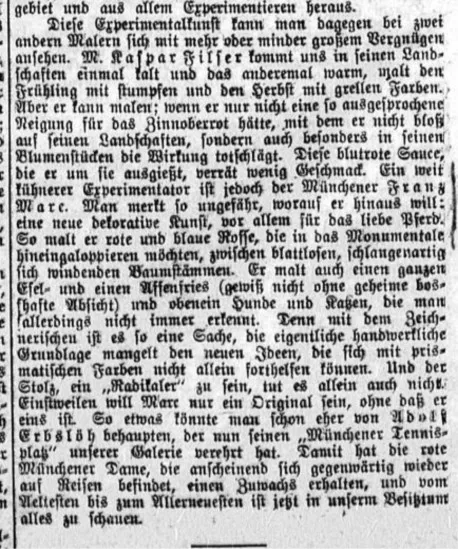
“A far bolder experimenter is the Munich painter Franz Marc”: Barmer Zeitung, 12 June 1911 (excerpt). Public domain. Scan: ULB Bonn, zeit.punkt NRW
Marc, the critic writes, wants “a new decorative art, above all for the dear horse. So he paints red and blue steeds that would like to gallop into the monumental”. He paints “a whole frieze of donkeys and monkeys” too, and “dogs and cats, which one does not always recognise”. For now, Marc just wants “to be an original”.
The public sees it differently, or comes precisely because of the fuss. Three years later the society’s board does the arithmetic: the June 1911 show with Marc’s paintings drew “1,209 visiting members, a number never reached again”. The board draws a remarkable conclusion. Interest was greatest, it seems, in the shows whose works were “most fiercely criticised”. In July 1911 the Barmer Zeitung reports that Weidende Pferde (Grazing Horses), Lammträger (Lamb Bearer) and Badende Frauen (Bathing Women) have been sold, and that a patron has given the society’s gallery the painting Weibliche Akte auf Rot (Female Nudes on Red). Which versions these were the report does not say.
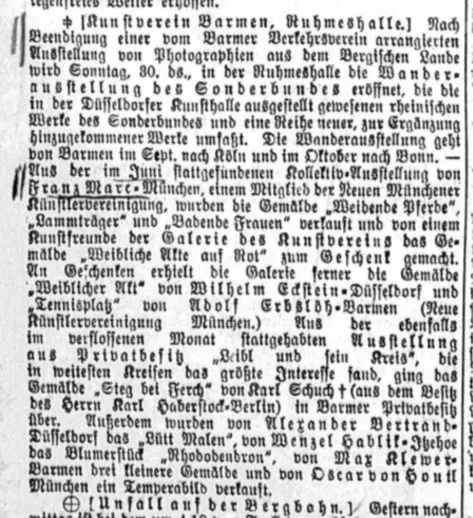
Barmer Zeitung, 26 July 1911 (excerpt). Public domain. Scan: ULB Bonn, zeit.punkt NRW
A painter Munich barely knows is selling in the industrial Rhineland. It is the start of a story you can follow in the newspapers of the day, and one that has now come back to the region: the Kunstsammlung Nordrhein-Westfalen is showing Franz Marc at K20 in Düsseldorf until January 2027, before the exhibition moves to Bern.
A painter’s son
Franz Marc is born in Munich on 8 February 1880. His father Wilhelm Marc paints landscapes and genre scenes, his mother Sophie comes from Alsace, and his elder brother Paul will become a Byzantinist. As a boy Franz wants to be a pastor, then a teacher. Only after military service, in autumn 1900, does he settle on painting and enrol at the Munich Academy under Gabriel von Hackl and Wilhelm von Diez. A trip to Paris in 1903 pulls him away from the Academy. He searches for a long time, often depressed; in 1906 he travels to Greece with his brother, and in 1907 he is back in Paris, where van Gogh and Gauguin make a lasting impression.
In March 1905 he appears for the first time in an exhibition list of the Munich Kunstverein, with “4 pictures and studies” among mountain scenes and genre pieces. Two years later, in March 1907, a short notice shows what he was already working on.
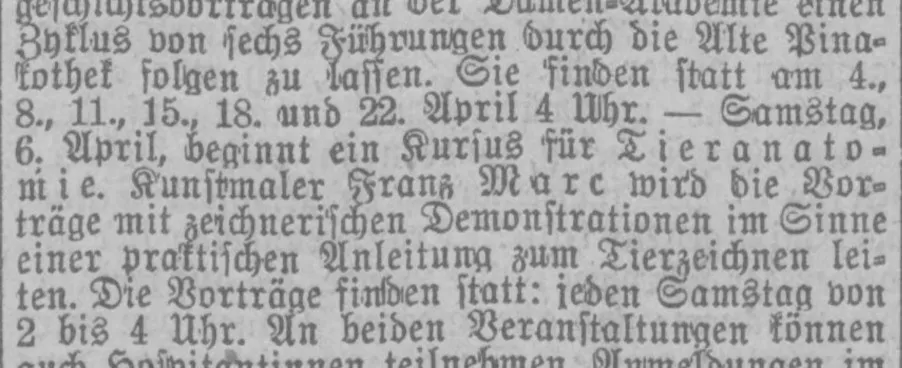
Münchner Neueste Nachrichten, 5 March 1907 (excerpt). Public domain. Scan: Bayerische Staatsbibliothek, digiPress
From Saturday 6 April, it says, “a course in animal anatomy begins. The painter Franz Marc will lead the lectures with drawn demonstrations, as practical instruction in drawing animals”, every Saturday from two to four. Women auditors may attend as well, so the course was evidently held at a ladies’ art academy. The painter of blue horses first taught the animal as an anatomist, and even his harshest critics would later notice how well he knew it.
1907 is a year of ruptures. His father dies; in December the Kunstverein shows his estate “in two series”. The same year Franz marries the painter Marie Schnür, and the marriage leaves one trace in the papers: at a Munich artists’ ball in December, “Fr. Marc-Schnür” leads a group of “fantastic figures from the sea bed”. They divorce in 1908. That summer Marc paints at Lenggries with Maria Franck, a painter from a Berlin banking family, whom he will marry in 1913.
Sindelsdorf and friends
In February 1910 the Munich dealer Brakl shows a group of works by “the young Munich painter Franz Marc” in his gallery on Goethestraße. Looking back in 1916, the Münchner Neueste Nachrichten recalls how the “almost unknown painter” surprised visitors there with “very respectable skill” and a “fine and distinctive feeling for nature”.
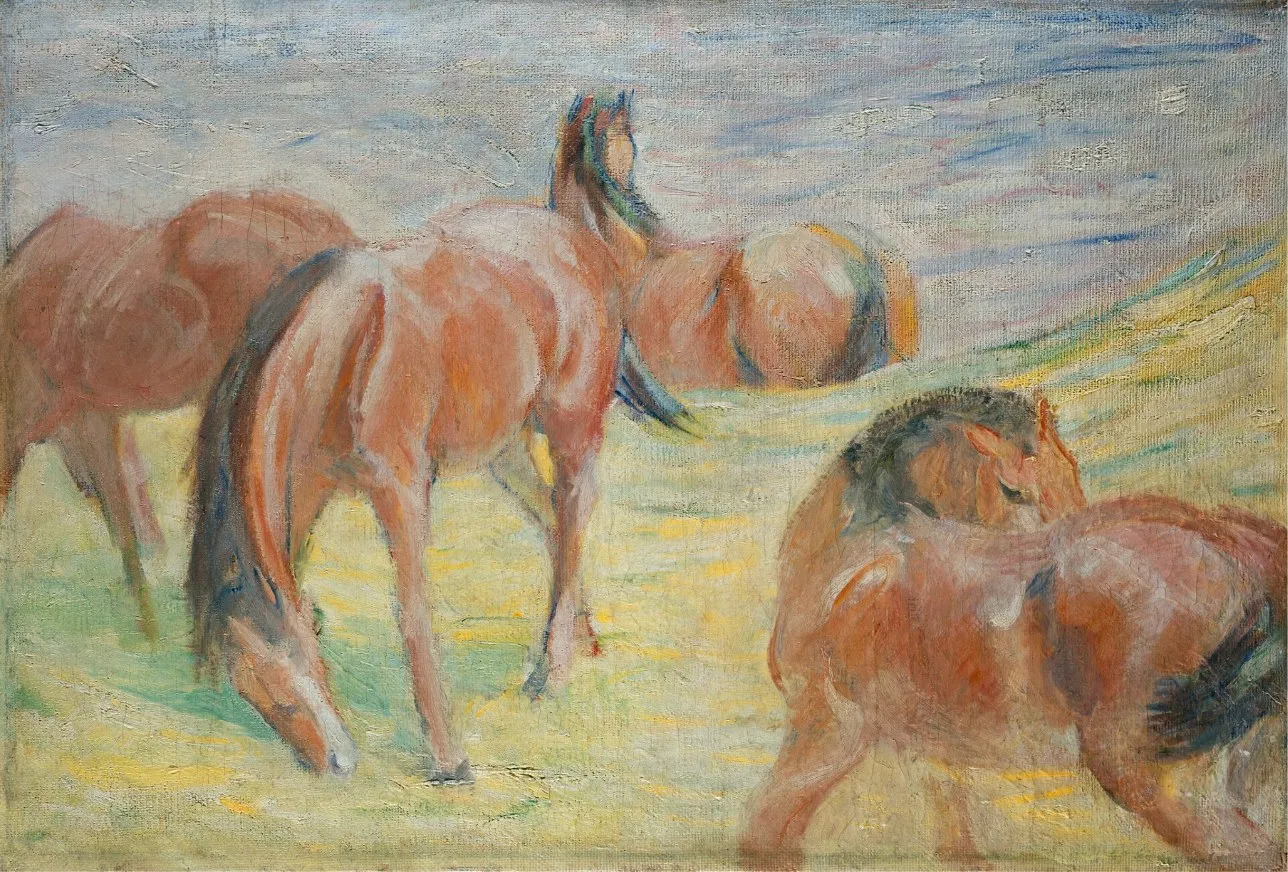
Franz Marc, Weidende Pferde I (Grazing Horses I), 1910, oil on canvas, Städtische Galerie im Lenbachhaus, Munich. Public domain. Photo: Lenbachhaus, Munich, CC BY-SA 4.0, via Wikimedia Commons
In January 1910 August Macke and the Berlin collector Bernhard Koehler had already visited his studio, the beginning of a close friendship. Koehler soon pays Marc a monthly allowance. Marc moves to the country, to Sindelsdorf at the edge of the Alps, where he can watch animals outdoors. A year later a Munich hotel’s guest list, printed in the paper, records two visitors from the village.
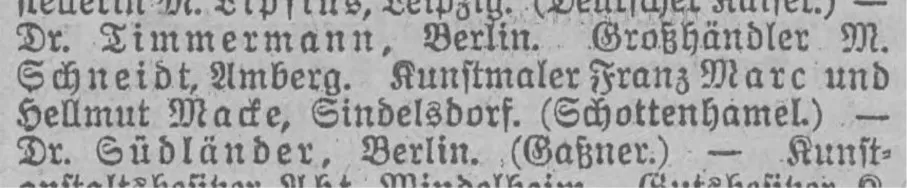
Münchner Neueste Nachrichten, 28 January 1911 (excerpt). Public domain. Scan: Bayerische Staatsbibliothek, digiPress
“Hellmut Macke” is Helmuth Macke, August’s cousin, who was living and painting with Marc in Sindelsdorf. That year Marc arrives at the work he is known for. The horses turn blue, the cows yellow, the hills red. Colour no longer describes how things look but what they mean. Blue, he wrote to Macke in December 1910, stood for the male and spiritual, yellow for the female and gentle, red for heavy matter.
In December 1911, with Wassily Kandinsky and Gabriele Münter, he leaves the Neue Künstlervereinigung München after its jury rejects a large painting by Kandinsky. On 18 December the first “Der Blaue Reiter” exhibition opens at Thannhauser’s gallery, with four paintings by Marc. In May 1912 the almanac of the same name follows, co-edited with Kandinsky: essays, children’s drawings, Bavarian glass paintings and folk art alongside the friends’ own pictures.
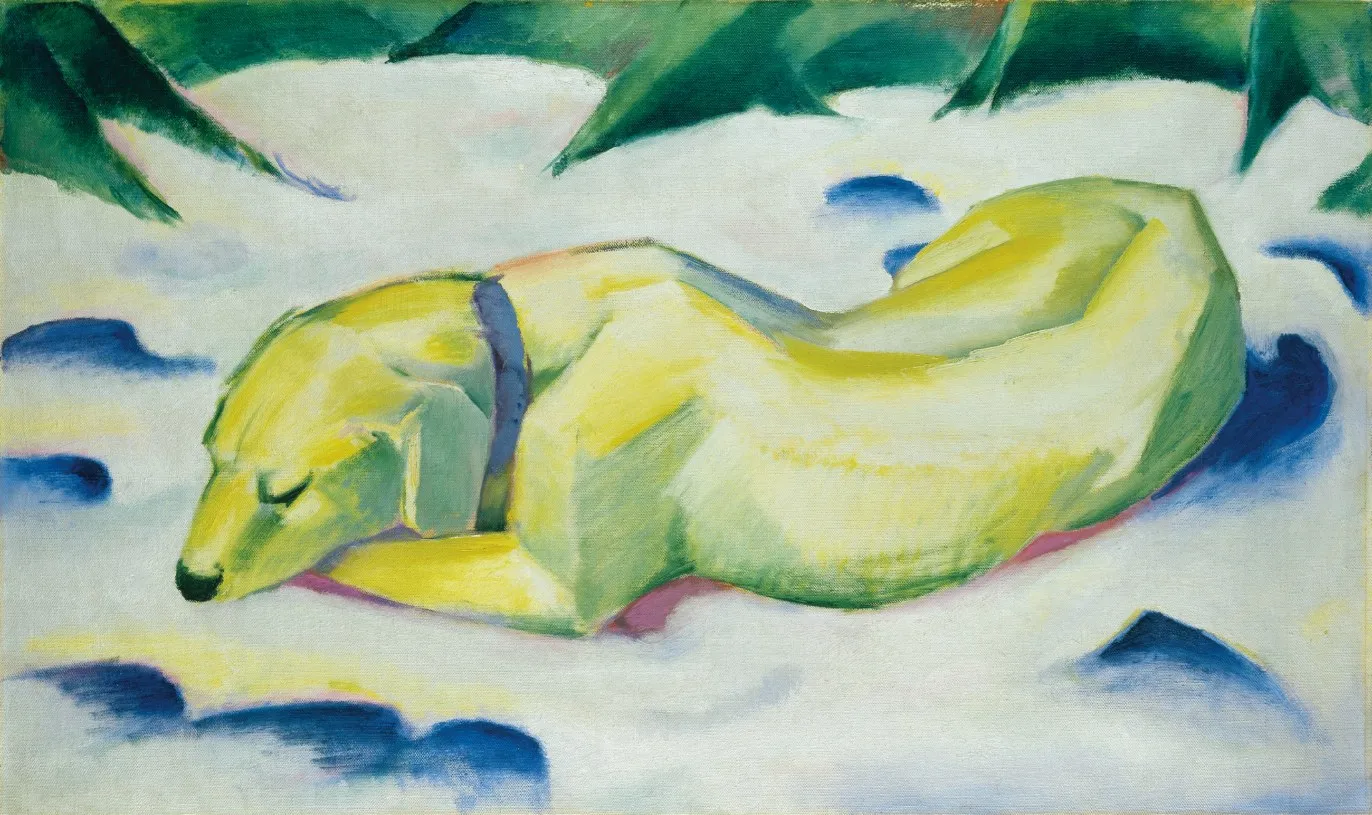
Franz Marc, Liegender Hund im Schnee (Dog Lying in the Snow), c. 1911, oil on canvas, 62.5 × 105 cm, Städel Museum, Frankfurt am Main. Public domain. Photo: Städel Museum, Wikimedia Commons
A market in the west
While Munich argues about the Blue Rider, museums and collectors in the west are buying. In November 1911 the Folkwang Museum in Hagen shows “paintings by Franz Marc, Munich”. The Hagener Zeitung is torn: his draughtsmanship, his eye “extraordinarily receptive to the movement of the animal body” and his “assurance in anatomical treatment, acquired through careful study” are beyond doubt, but his colour rises to “repellent brutality”. In January 1912 Münster sees “the two much-discussed animal pictures (donkey and coloured cows)”. And on 30 January 1912 Barmen reports a sale that counts as a small sensation.
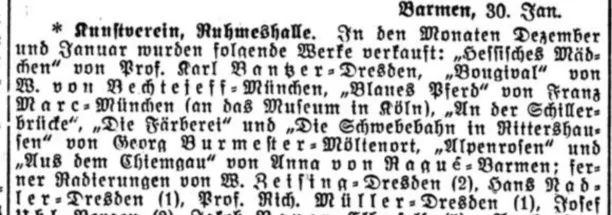
Neueste Nachrichten für Elberfeld-Barmen, 30 January 1912 (excerpt). Public domain. Scan: ULB Bonn, zeit.punkt NRW
A “Blaues Pferd” (Blue Horse) by Marc goes from the Barmen show “to the museum in Cologne”, little more than a year after he first painted the motif. Which of the blue horses it was the notice does not say; the Düsseldorfer Generalanzeiger reports only that it went “to a Rhenish museum”.
The sales continue. At the great Sonderbund exhibition in Cologne in summer 1912, which gathers van Gogh, Cézanne, Picasso and the young Germans, Marc’s Katzen (Cats) is sold. In October 1912 he is back in Barmen, between Kees van Dongen and the Düsseldorf horse painter Albert Reibmayr. One critic finds his work now “under the influence” of “the latest tendencies known as Futurism and Cubism”. A week later another tries irony: the name “Der Blaue Reiter” sounds “like the title of a fairy tale”. But even he concedes that Marc is “by no means without talent”, and that in his Cubist pictures he captures “the character of an animal organism”. In December 1912 the society lists its sales of the past three months: one Kandinsky, one Kokoschka, two Munchs, and by Franz Marc “5 paintings and 1 lithograph”.
Not everyone is won over. In February 1913 the critic of the Düsseldorfer Generalanzeiger meets Marc’s work at Thannhauser’s in Munich and sighs.
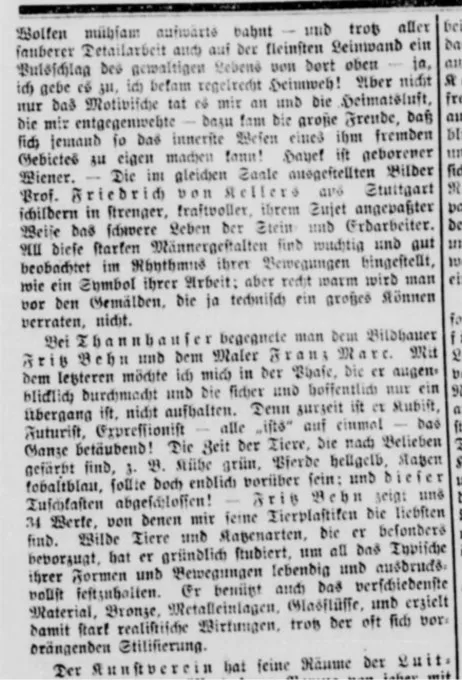
Düsseldorfer Generalanzeiger, 10 February 1913 (excerpt). Public domain. Scan: ULB Bonn, zeit.punkt NRW
“For at present he is a Cubist, Futurist, Expressionist – all the ‘ists’ at once – the whole thing is deafening! The time of animals coloured at will, cows green, horses pale yellow, cats cobalt blue, ought surely to be over; and this paintbox closed!”
Two months later, according to the Kölnische Zeitung, “the painters Franz Marc, Schmidt-Rottluff and Nolde” were to be elected to the board of the Cologne Sonderbund, the leading exhibiting society for modern art in the Rhineland, though the society was tearing itself apart at the time. In summer 1913 Marc visits Bonn, where August Macke has gathered a small artists’ colony around him. The art historian Walter Cohen, recalling those days at Grau-Rheindorf on the left bank of the Rhine in 1920, names Macke as its centre, and “one of the most frequent guests in this Bonn circle was Macke’s older friend Franz Marc, whom he admired almost with reverence”.
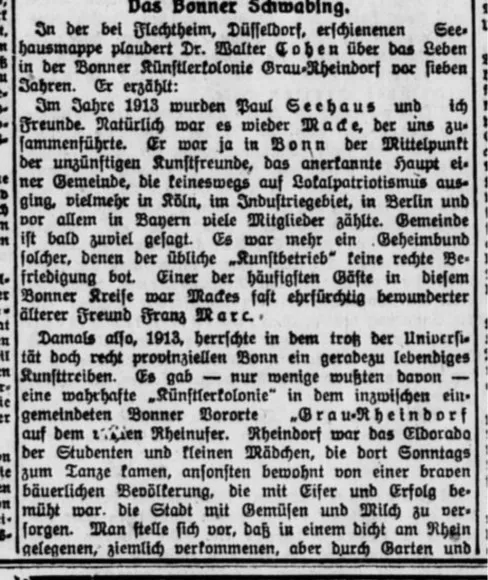
“The Bonn Schwabing”: General-Anzeiger, Bonn, 25 August 1920 (excerpt). Public domain. Scan: ULB Bonn, zeit.punkt NRW
The Tower of Blue Horses
In autumn 1913 Herwarth Walden, editor of the magazine Der Sturm, stages the First German Autumn Salon in Berlin, a survey of the European avant-garde. Marc, with Macke, helped choose the works. For the critic Robert Breuer the show is an “art disease”, and he pours scorn on almost everything. With Marc he pauses.
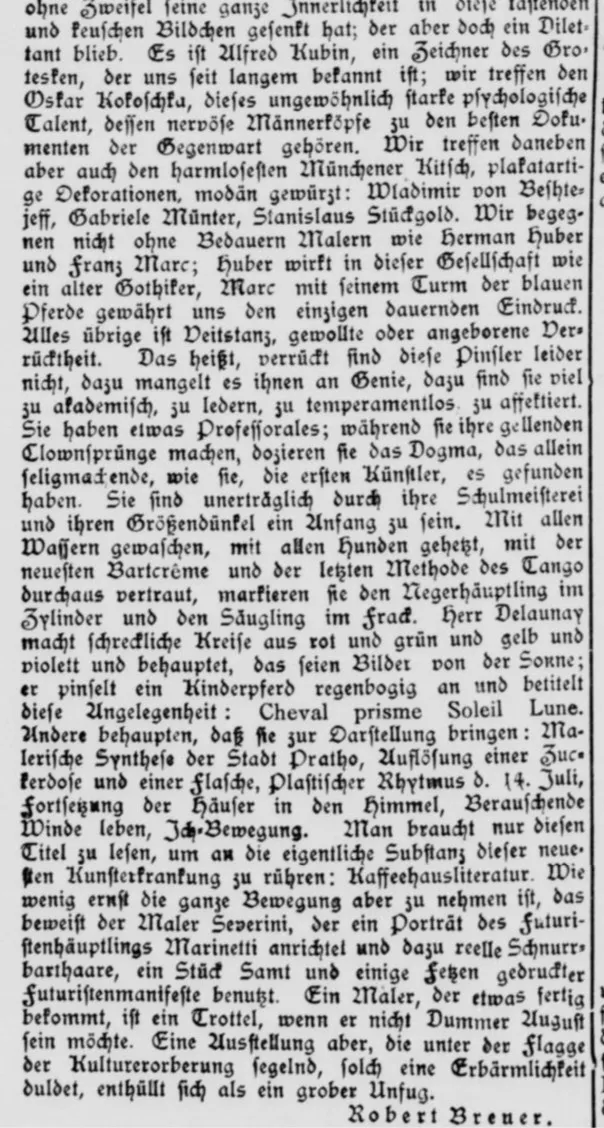
Düsseldorfer Abendblatt, 20 September 1913, review by Robert Breuer (excerpt). Public domain. Scan: ULB Bonn, zeit.punkt NRW
“We meet, not without regret, painters like Herman Huber and Franz Marc; Huber seems like an old Gothic master in this company, Marc with his Tower of Blue Horses gives us the only lasting impression. All the rest is St Vitus’s dance.”
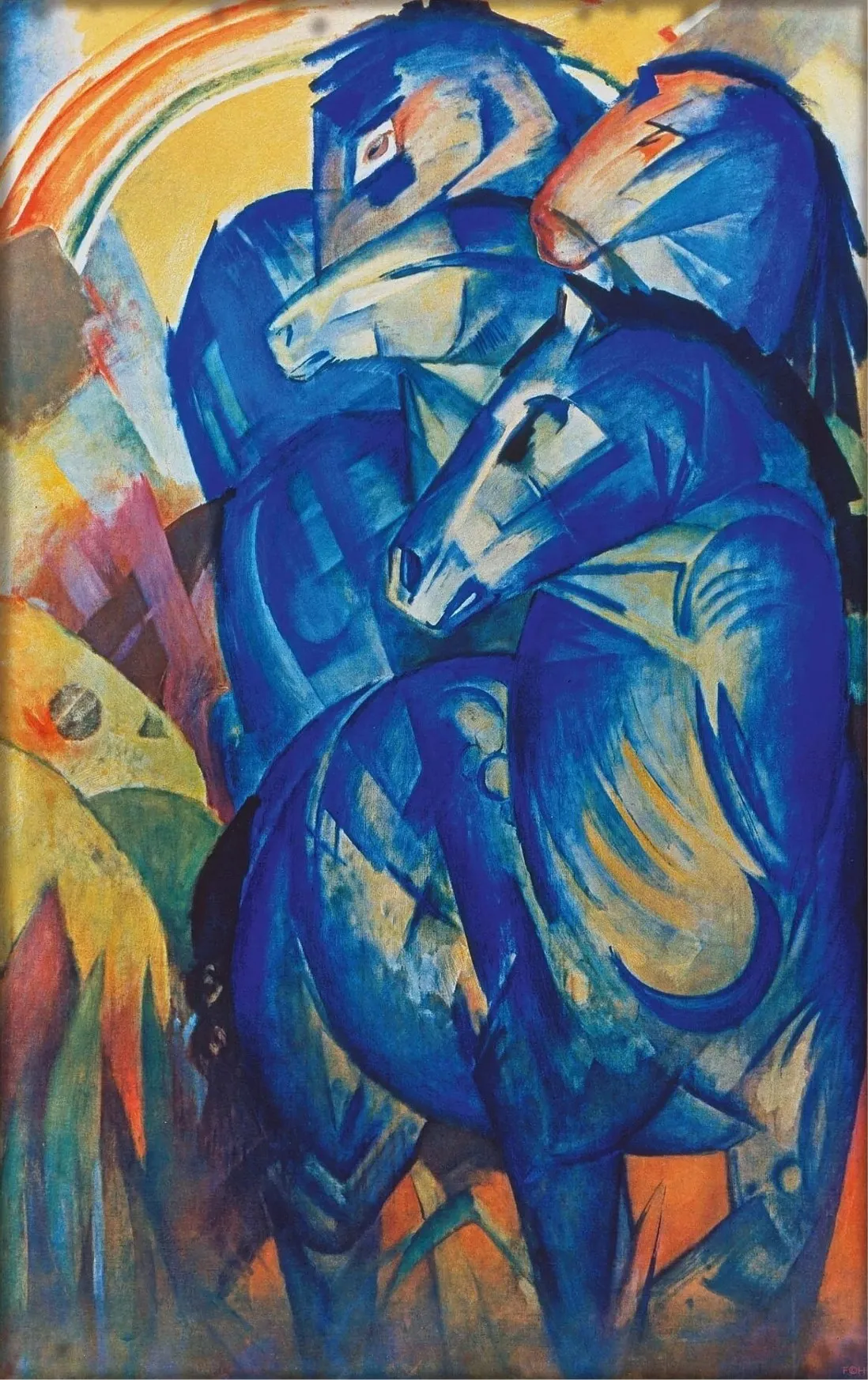
Franz Marc, Der Turm der blauen Pferde (The Tower of Blue Horses), 1913, oil on canvas, 200 × 130 cm, formerly Nationalgalerie, Berlin, missing since the Second World War. Public domain. Reproduction after a colour print, Wikimedia Commons; the original colours cannot be verified
The same year Marc paints a large canvas about catastrophe. A blue deer stretches its neck, red shafts fall through the picture like tree trunks, boars and horses cower. He calls it Tierschicksale (The Fate of the Animals) and writes on the back: “Und alles Sein ist flammend Leid” (And all being is flaming suffering). It has often been read as a premonition of war, and in wartime Marc saw it that way himself: “It is like a premonition of this war, horrible and moving; I can hardly imagine that I painted it.”
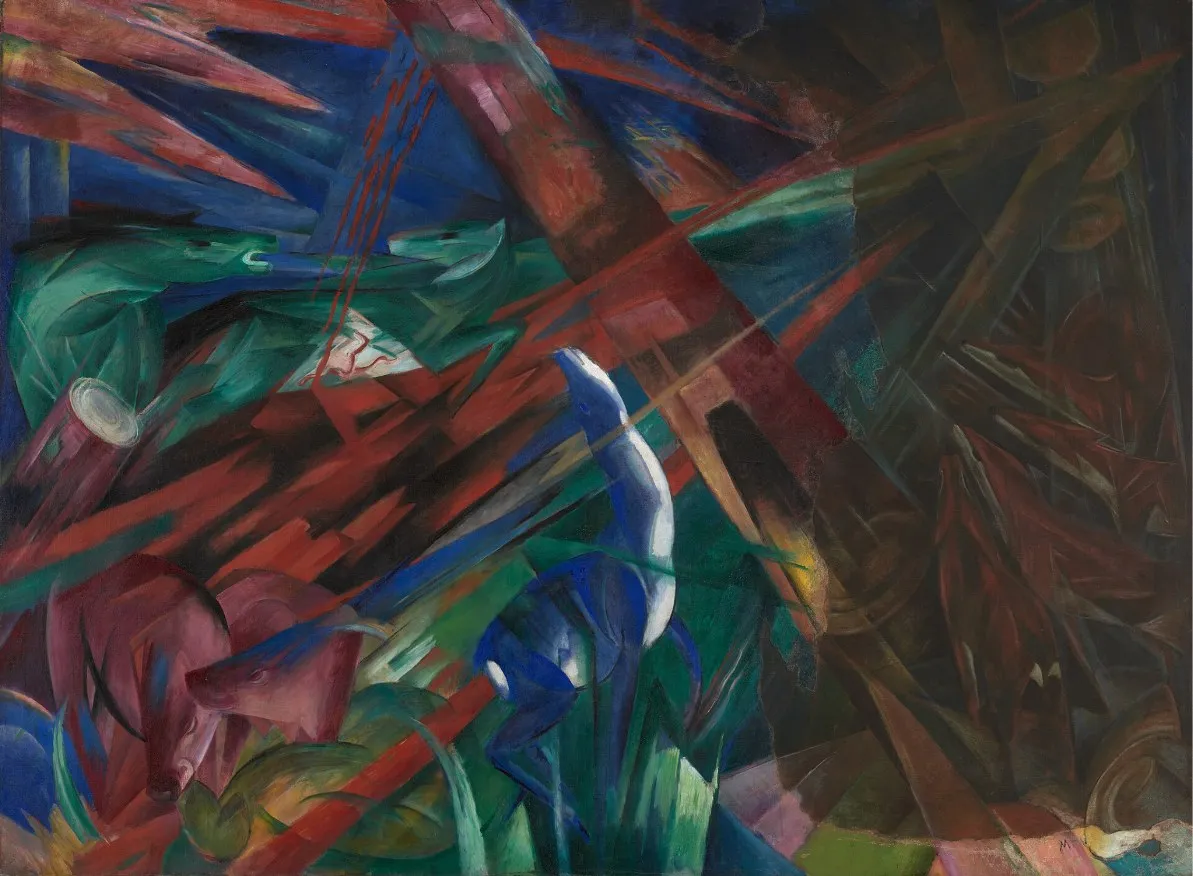
Franz Marc, Tierschicksale (The Fate of the Animals), 1913, oil on canvas, 195 × 268 cm, Kunstmuseum Basel. The right third was repainted by Paul Klee after a fire. Public domain. Photo: Kunstmuseum Basel, Wikimedia Commons
In spring 1914 Marc and Maria move into their own house at Ried near Kochel. His paintings become more abstract. In Kämpfende Formen (Fighting Forms) no animals remain, only a red and a black vortex crashing into each other.
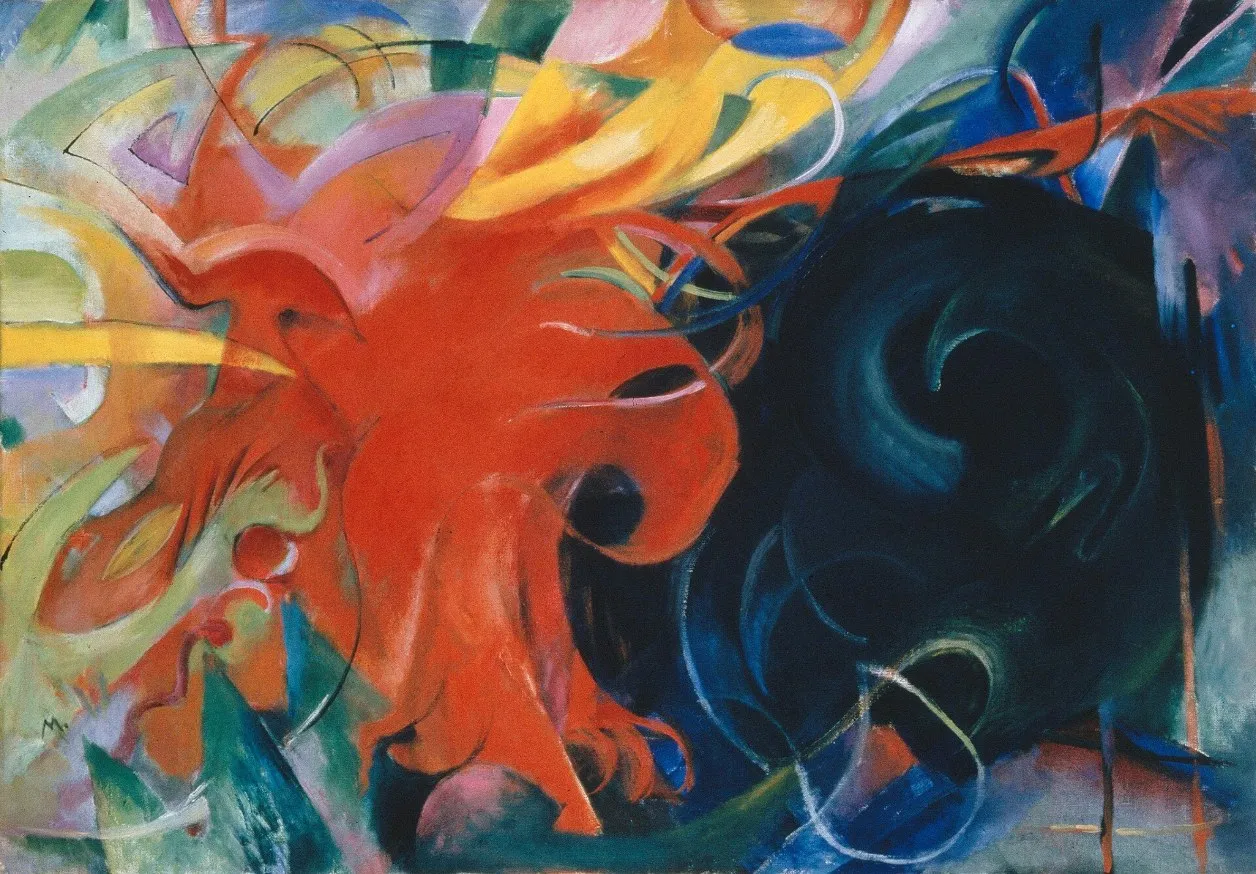
Franz Marc, Kämpfende Formen (Fighting Forms), 1914, oil on canvas, Pinakothek der Moderne, Munich. Public domain. Photo: Bayerische Staatsgemäldesammlungen, Wikimedia Commons
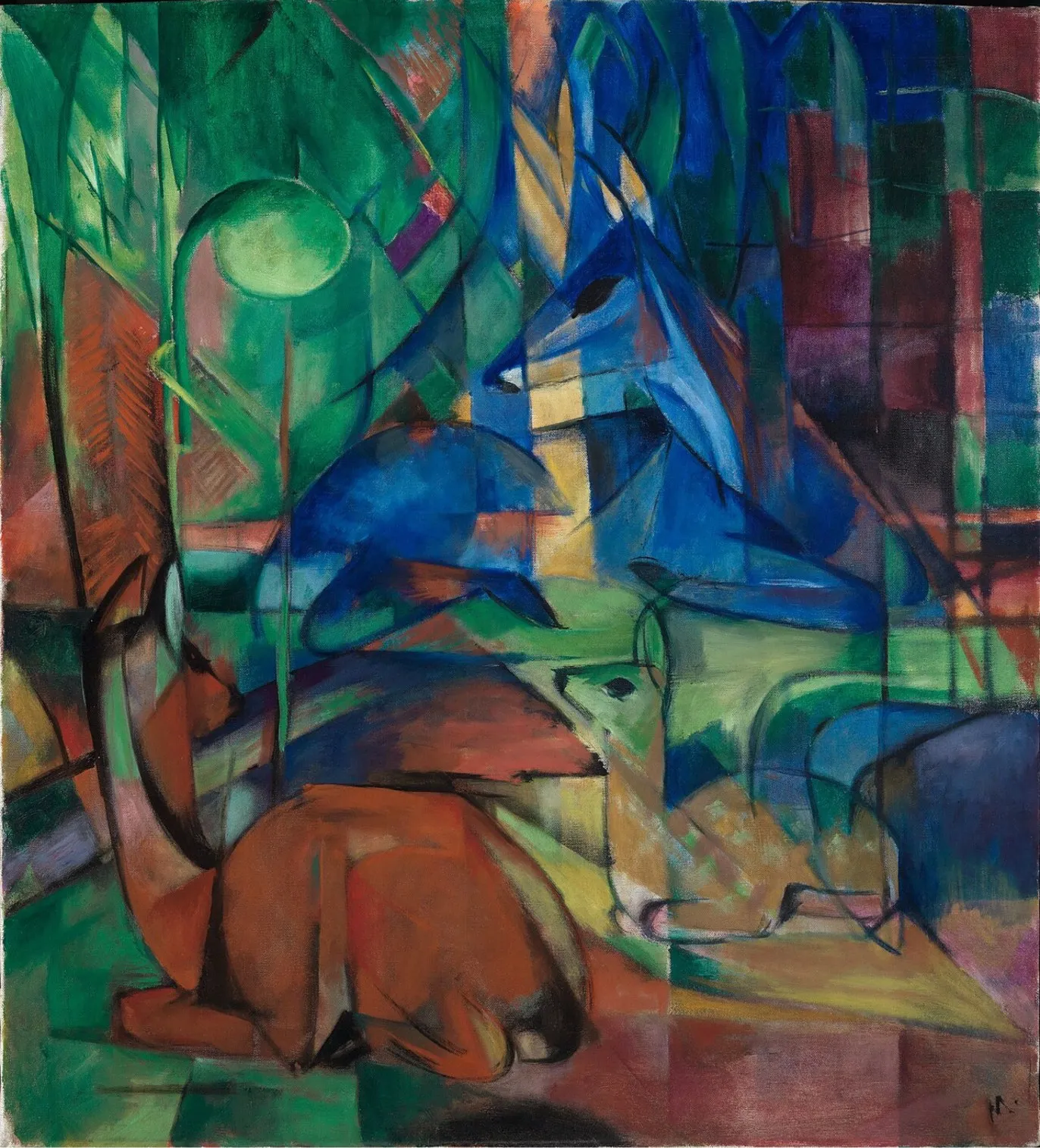
Franz Marc, Rehe im Walde II (Deer in the Forest II), 1914, oil on canvas, Staatliche Kunsthalle Karlsruhe. Public domain. Photo: Staatliche Kunsthalle Karlsruhe, Wikimedia Commons
War and letters from the front
On 1 August 1914 Marc volunteers. He serves in the Bavarian field artillery; in October 1915 he appears on a promotion list as a Vizewachtmeister (sergeant) of the replacement field artillery regiment, and by 1916 the papers call him a lieutenant. He writes to Maria again and again, often several times a week. In 1920 she publishes the letters with Paul Cassirer, together with his notes and a sketchbook. They are the best source for these eighteen months, and they show a man changing.
The first letter, written in Alsace on 1 September 1914, sounds almost cheerful. He has kept his first night watch: “it was very atmospheric, a wonderful autumn night full of stars. How different all this is from that boring garrison duty!” He sees no danger. In October he writes that he has become “more German than ever”. But as early as September he asks the question that keeps returning in the letters: “When will I be allowed to paint again?”
Then he learns that August Macke was killed in Champagne on 26 September. “Oh dearest, August’s death is so terrible to me,” he writes on 23 October; “the bare fact simply will not go into my head.” Two days later: “I cannot get over August’s death. How much we have all lost; it is like a murder.” The idea of dying for the common cause, “the soldier’s notion of death that is otherwise so familiar to me”, he cannot apply to his friend.
In March 1915 the collector Bernhard Koehler sends him a postcard from the Sturm gallery showing Tierschicksale (The Fate of the Animals). Marc is “quite shaken and stirred”. In the same letter of 17 March there is a sentence that is easy to miss: “I am now quietly beginning to draw in the sketchbook. It relieves and restores me.”
That sketchbook survives. In 1920 Maria Marc published it in collotype as the second volume of the letters, a “faithful reproduction of the last sketchbook from the field”. Its 35 pages show no trenches and no soldiers. They are pencil drawings of forms, vortices and crystals, with animals appearing again and again. You can see in them the new forms he writes about in his letters.
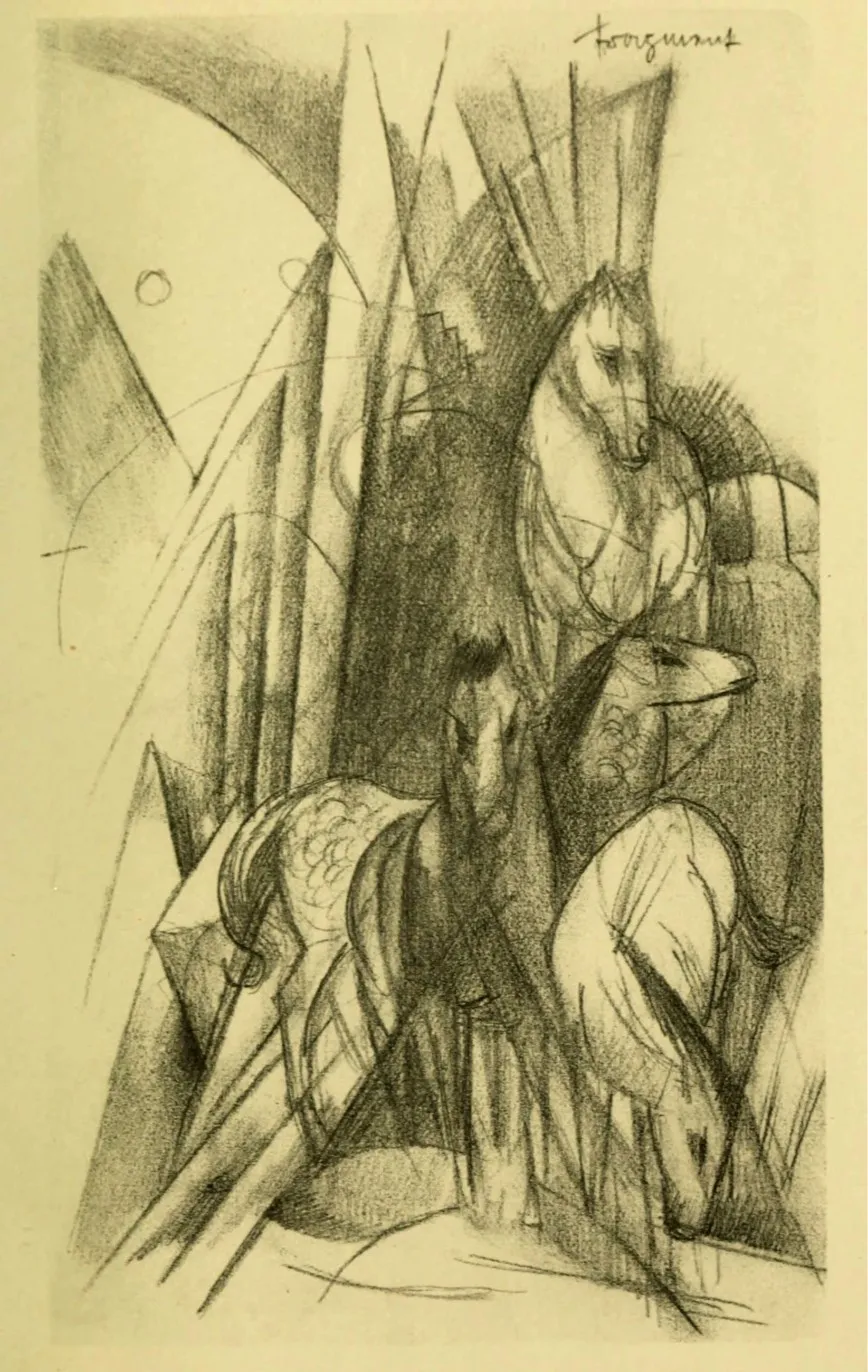
Franz Marc, page from the Sketchbook from the Field, 1915, pencil. Collotype in: Franz Marc, Briefe, Aufzeichnungen und Aphorismen, vol. 2, Berlin 1920, plate 63. Public domain. Scan: Internet Archive, Project Gutenberg
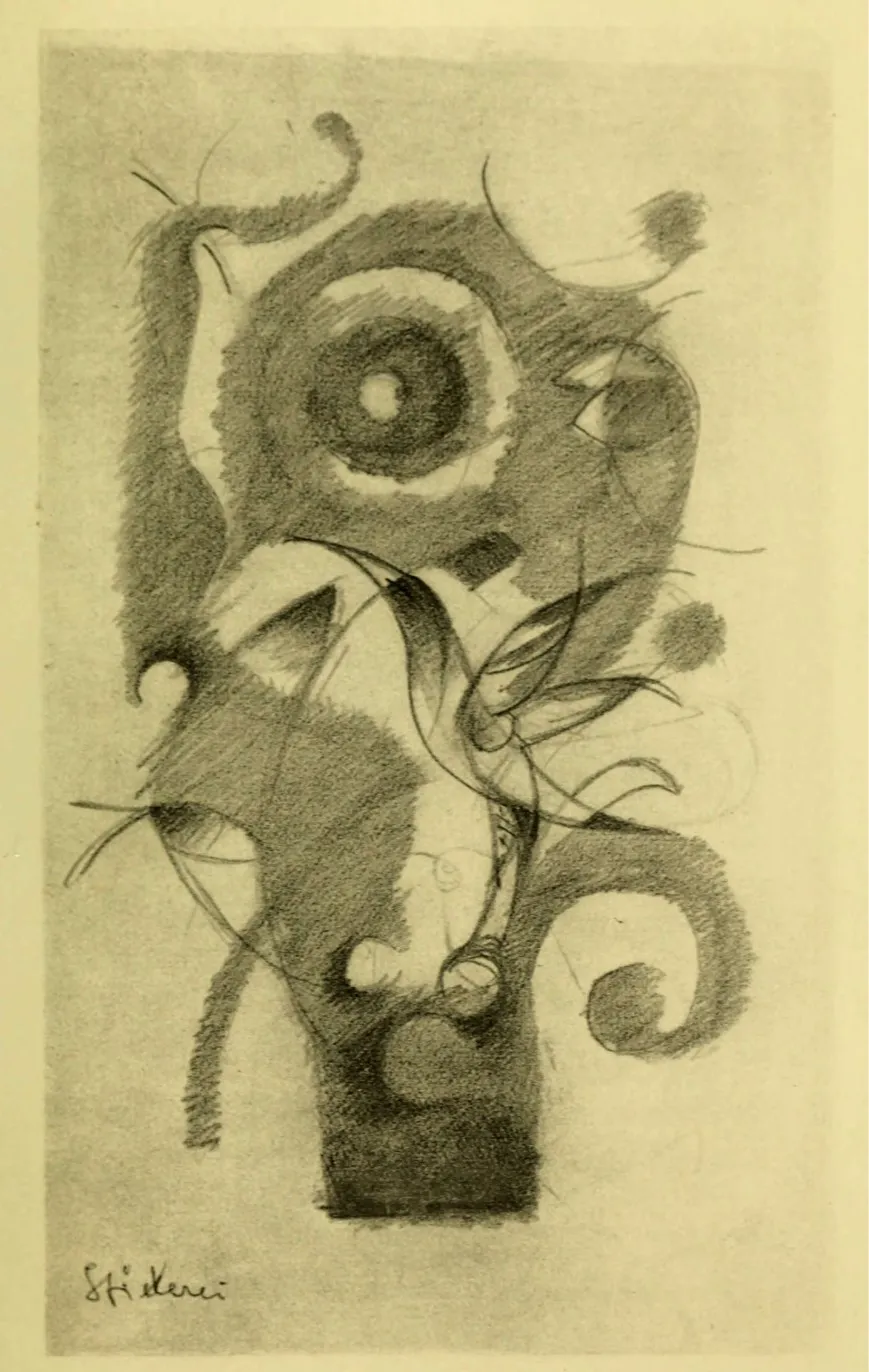
Franz Marc, page from the Sketchbook from the Field, 1915, pencil. Collotype in: Franz Marc, Briefe, Aufzeichnungen und Aphorismen, vol. 2, Berlin 1920, plate 25. Public domain. Scan: Internet Archive, Project Gutenberg
In February 1916 the German offensive at Verdun begins, and Marc’s unit is part of it. “Now we are right in the middle of this most monstrous of all days of war,” he writes on 27 February. “No one who has not been through it can have any idea of the insane fury and force of the German assault.” And then, in the middle of the report, three words from the animal painter: “The poor horses!”
On 4 March 1916 he answers the letter Maria had written for his birthday, which he had long thought lost. “Yes, this year I shall come back to my unharmed, dear home, to you and to my work. Amid the boundless, horrifying images of destruction among which I now live, this thought of homecoming has a halo that cannot be described lovingly enough.” It is his last letter. By the afternoon of the same day he is dead, killed on a reconnaissance near Braquis, east of Verdun.
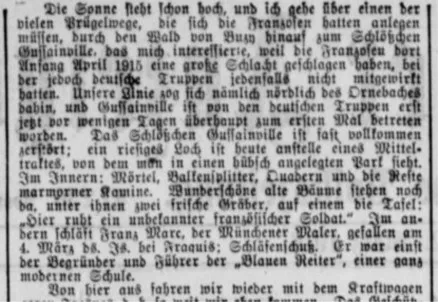
The news reaches the papers in fragments. On 1 April the Munich Allgemeine Zeitung writes that the “Bavarian artillery lieutenant Franz Marc” fell “on 4 March near Etain” and lies “buried at Gussainville in a quiet French landscape such as he loved”. A war correspondent, whose report the Münsterischer Anzeiger prints on 22 March, is more precise. He visits the shelled château of Gussainville and finds two fresh graves in its park.
Münsterischer Anzeiger, 22 March 1916 (excerpt). Public domain. Scan: ULB Münster, zeit.punkt NRW
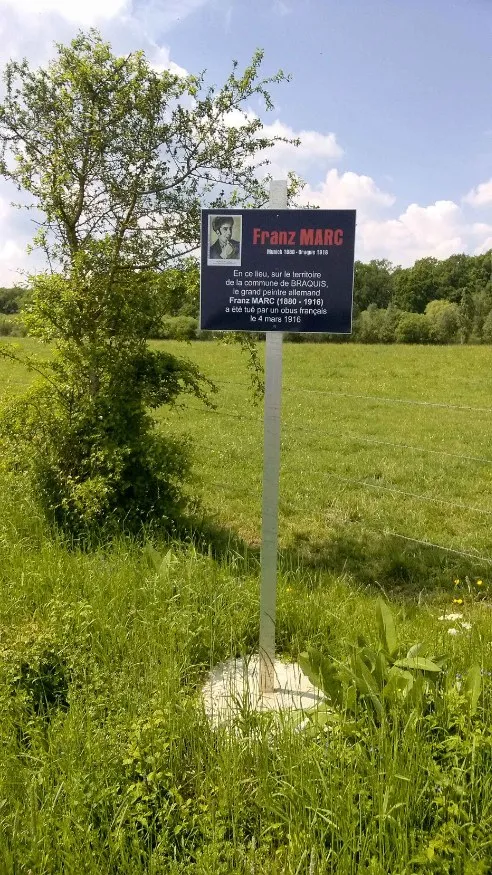
One bears the words: “Here lies an unknown French soldier.” In the other “sleeps Franz Marc, the Munich painter, fallen on 4 March this year at Fraquis; shot through the temple. He was once the founder and leader of the ‘Blaue Reiter’, a very modern school.” “Fraquis” is a misprint or mishearing of Braquis. Later accounts speak of a shell splinter that struck him in the head, which fits the report. Today a plaque at the edge of Braquis records that “le grand peintre allemand” was killed here on 4 March 1916 “par un obus français”, by a French shell. In 1917 his body is brought to Kochel am See, where he is buried.
Memorial plaque at the place where Franz Marc died, near Braquis (Meuse). Photo: Bueckler, Wikimedia Commons, CC BY-SA 4.0
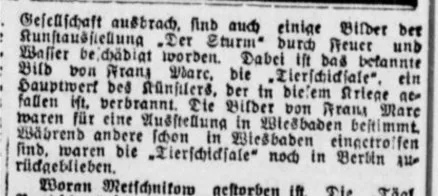
The picture later read as his premonition did not come through the war unscathed either. On 4 March 1917, a year to the day after Marc’s death, the Dortmunder Zeitung reports that a fire in Berlin has damaged pictures from the Sturm gallery. “Among them the well-known painting by Franz Marc, ‘Tierschicksale’, a major work by the artist, who fell in this war, has been burnt.”
Dortmunder Zeitung, 4 March 1917 (excerpt). Public domain. Scan: ULB Münster, zeit.punkt NRW
The report was only half right. The painting, meant for an exhibition in Wiesbaden, had stayed behind in Berlin; it did not burn entirely, but its right third was destroyed. Paul Klee, Marc’s friend from the Blue Rider, later repainted that section from a photograph, and that is how it hangs in the Kunstmuseum Basel today. Recent accounts usually date the fire to 1916; the newspaper report suggests it was more likely the winter of 1916–17.
The fallen hero
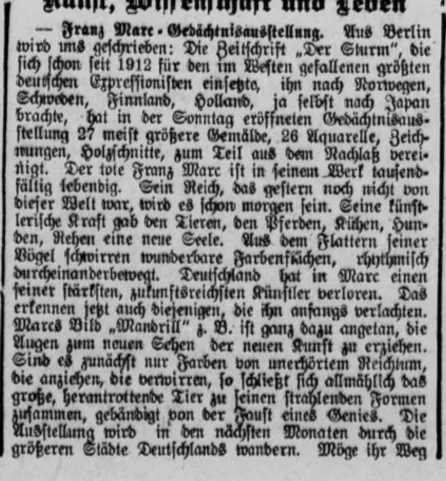
With Marc dead, the tone changes. In March 1916 the Kölnische Zeitung counts him among “the strongest and most promising talents who championed the newest art in Germany”. At the end of October 1916 Herwarth Walden opens a memorial exhibition in Berlin with “27 mostly large paintings, 26 watercolours, drawings and woodcuts, partly from the estate”.
Bonner Zeitung, 1 November 1916 (excerpt). Public domain. Scan: ULB Bonn, zeit.punkt NRW
“In Marc, Germany has lost one of its strongest artists, the richest in promise,” the report says. “Even those who laughed at him at first now recognise it.” In 1920 his letters from the front are published; in 1930, for his fiftieth birthday, the Cologne gallery Abels shows watercolours and drawings “from the collection of the artist’s widow”. Marc has become a classic, and he is a fallen soldier of the World War. After 1933 that second role matters.
Between “German art” and “degeneracy”
In summer 1933 it is still undecided how the new regime will treat Expressionism. In July the art historian Alois Schardt, newly appointed acting director of the Berlin Nationalgalerie, gives a programmatic lecture on “the concept of German art”; the Kölnische Zeitung calls it a “passionate declaration for artists such as Marc, Barlach, Lehmbruck, Nolde, Heckel, Feininger”. A group of National Socialist students in Berlin, keen to rescue Expressionism as German art, shows “thirty older and younger German artists” at Ferdinand Möller’s gallery; among the older ones are Barlach, Kolbe, Lehmbruck, Nolde, Rohlfs and “Franz Marc (fallen 1916)”. The show opens, the Kölnische Zeitung writes in August, “with Franz Marc’s wonderful picture ‘Die Angst der Hasen’” (The Hares’ Fear).
In autumn 1933 Essen hosts “Westfront 1933”, organised by the Propaganda Ministry and the Kampfbund für deutsche Kultur. The Münsterischer Anzeiger describes the main hall: “splendid works by the three fallen painters of genius, Franz Marc, August Macke (Meschede) and Wilhelm Morgner (Soest)” on a single wall. In December the Lüdenscheider General-Anzeiger quotes a young artist who hails the show as proof of a new direction.
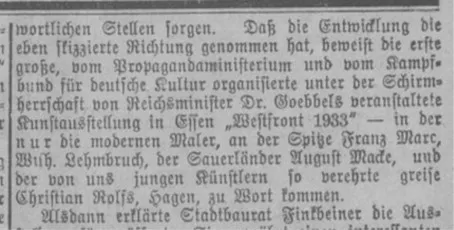
Lüdenscheider General-Anzeiger, 11 December 1933 (excerpt). Public domain. Scan: ULB Münster, zeit.punkt NRW
The exhibition “Westfront 1933” in Essen, “held under the patronage of Reich Minister Dr Goebbels”, gives a voice “only to the modern painters, with Franz Marc at their head”. As late as October 1934 the same paper asks: “Would Franz Marc, who fell in the front line in the World War in 1916, aged 37, and would now be past 55, a true member of the front-line generation that sets the tone today, have to relearn?”
In March 1936, on the twentieth anniversary of his death, the Kestner-Gesellschaft in Hanover opens a memorial exhibition with 150 works. The loans come from the Nationalgalerie in Berlin, from Düsseldorf, Hamburg, Cologne, Krefeld, Mannheim and from the Ruhmeshalle, the building where it all began in 1911.
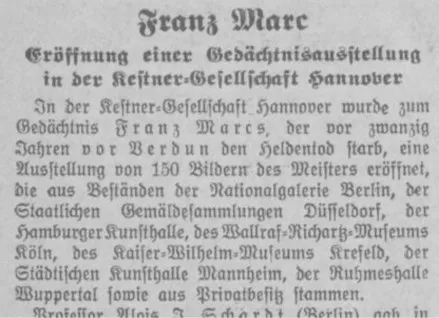
Kölnische Zeitung, 6 March 1936 (excerpt). Public domain. Scan: ULB Bonn, zeit.punkt NRW
Sixteen months later it is over. On 19 July 1937 the “Entartete Kunst” (Degenerate Art) exhibition opens in Munich. Papers print descriptions of its rooms, and one names what hangs there.
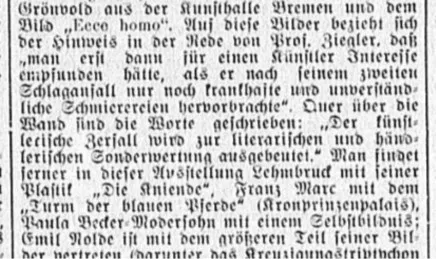
Westfälische Zeitung, 22 July 1937 (excerpt). Public domain. Scan: ULB Münster, zeit.punkt NRW
“One further finds in this exhibition Lehmbruck with his sculpture ‘Die Kniende’, Franz Marc with the ‘Turm der blauen Pferde’ (Kronprinzenpalais), Paula Becker-Modersohn with a self-portrait.” The painting that made “the only lasting impression” in 1913 has come from the Kronprinzenpalais, the Nationalgalerie’s branch for contemporary art. According to later accounts, the German Officers’ League protested at a fallen officer being paraded as “degenerate”, and the picture was taken out of the show. It passed into the hands of Hermann Göring and has been missing since the end of the Second World War. Some 130 of Marc’s works were seized from German museums in 1937.
Today
The “red and blue steeds” mocked in Barmen in 1911 are now among the best-known images in German art. Many hang in Munich, at the Lenbachhaus and the Pinakothek der Moderne, and in the Franz Marc Museum at Kochel, a few kilometres from his grave.
The Kunstsammlung Nordrhein-Westfalen is showing Franz Marc. Die Suche nach einer besseren Welt (The Quest for a Better World) at K20 in Düsseldorf until 24 January 2027; from 26 February 2027 it travels to the Kunstmuseum Bern. Visitors may think of the Barmer Zeitung of 1911, which called Marc “an original” and meant it as a reproach.
Sources
- Münchner Neueste Nachrichten, 25 March 1905, 5 March 1907, 7 February 1910, 28 January 1911, 20 October 1915, 15 March 1916, 2 January 1918, 20 January 1921
- Allgemeine Zeitung, Munich, 12 December 1907, 13 May 1911, 1 April 1916
- Barmer Zeitung, 3 June, 12 June and 26 July 1911, 5 October, 12 October and 5 December 1912, 14 February 1914
- Neueste Nachrichten für Elberfeld-Barmen, 27 May 1911, 30 January 1912
- Hagener Zeitung, 4 and 10 November 1911
- Düsseldorfer Generalanzeiger, 12 January 1912, 10 February 1913
- Münstersche Zeitung, 20 January 1912
- Kölner Lokal-Anzeiger, 16 June 1912; Kölnische Zeitung, 6 July 1912, 24 April 1913, 9 March 1916, 18 January and 8 February 1930, 9 August 1933, 6 March 1936
- Düsseldorfer Abendblatt, 20 September 1913 (Robert Breuer)
- Münsterischer Anzeiger, 22 March 1916, 29 October 1933
- Bonner Zeitung, 1 November 1916; Dortmunder Zeitung, 4 March 1917
- General-Anzeiger, Bonn, 25 August 1920; Deutsche Reichs-Zeitung, Bonn, 25 July 1925
- Westfälische neueste Nachrichten, 7 July 1933; Der Mittag, Düsseldorf, 12 July 1933
- Lüdenscheider General-Anzeiger, 11 December 1933, 6 October 1934
- Westfälische Zeitung, 22 July 1937; Stadtanzeiger für Castrop-Rauxel, 1 August 1937
- Rosel Gollek: Marc, Franz. In: Neue Deutsche Biographie 16 (1990), pp. 106–108
- Deutsches Historisches Museum, LeMO: Franz Marc 1880–1916
- Franz Marc: Briefe, Aufzeichnungen und Aphorismen, 2 vols., Berlin: Paul Cassirer 1920; vol. 2: Skizzenbuch aus dem Felde (Project Gutenberg nos. 53845 and 53846). English translations of the letters: Artofactum
- Mémorial de Verdun: Destins de Verdun – Franz Marc (on his death and first grave)
- Smithsonian Magazine: Two New Exhibitions Celebrate a Long-Lost Painting, 2017 (on The Tower of Blue Horses)
- Kunstsammlung Nordrhein-Westfalen; Kunstmuseum Bern: Franz Marc. The Quest for a Better World
- Image credits: Wikimedia Commons (Lenbachhaus, Städel Museum, Kunstmuseum Basel, Staatliche Kunsthalle Karlsruhe, Bayerische Staatsgemäldesammlungen)
How we researched this
- More than 700 newspaper references from 1905 to 1939 reviewed and read in context
- 50 original clippings saved as scans, 15 of them shown here
- All letters from the front, 1914–1916, read and the Sketchbook from the Field examined
- Biographical data checked against reference works; images of works only with verified licences
Open questions – tips welcome
- Which “Blue Horse” went from Barmen to the museum in Cologne in January 1912?
- Which version of “Grazing Horses” was sold in Barmen in 1911?
- When exactly did “The Fate of the Animals” burn: 1916 or the winter of 1916–17?
Know more? Write to us at info@artofactum.com