A letter to the Academy
In October 1891 the inspector of the Düsseldorf Art Academy received an unusual letter. A young painter who had studied there for six years explained why he was leaving. “Only someone who has a goal clearly before his eyes finds the nearest path,” he wrote. “That is why I first fought my way from the dreadfully dusty highway of academic training through the hedge of the statutes into the open field.” There, he went on, the fresh air had soon softened what little dried-up reason modern paternalism still leaves to the young.
Then came a small artistic programme. The essence of a picture, he wrote, lay in the construction of a harmony of tones placed side by side on the surface. The field of harmony of light that the old Dutch masters had opened up was there to be developed further. And at the end, in French, the practical side: “Et maintenant la question pecuniaire.” He considered it his duty no longer to eat into the fruit of his parents’ long, hard work. It was time to put the calculation of his abilities to the test.
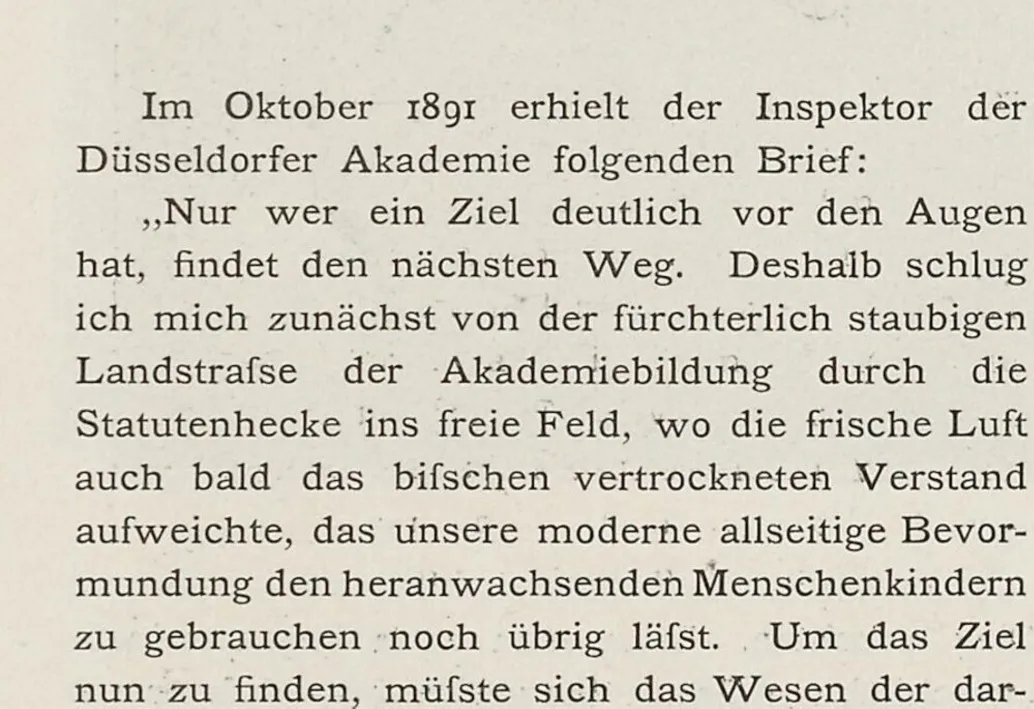
The letter of 1891, printed in Wilhelm Schäfer’s essay “Zwei Düsseldorfer Maler”, Die Rheinlande 1, 1900, no. 3, p. 20 (detail). Public domain. Scan: Heidelberg University Library
The writer was Wilhelm Schreuer, the son of a master baker from Cologne. Nine years later the writer Wilhelm Schäfer printed the letter in the new magazine Die Rheinlande, in a long essay about him. By then the headstrong academy student had become one of the most successful painters in Düsseldorf.
A baker’s son from the Lower Rhine
Wilhelm Schreuer was born on 28 September 1866 in Wesel. His father, a master baker, drew and painted watercolours in his spare time, above all churches and houses in Cologne, and he recognised his son’s talent early. When Wilhelm was a small boy the family moved to Cologne, the father’s home town; on the painter’s 60th birthday the Düsseldorf press gave the year as 1874, other sources say 1872. In Cologne he attended elementary and secondary school.
In 1884 he went to the Art Academy in Düsseldorf. He studied in the elementary classes under Heinrich Lauenstein and Hugo Crola; he never attended a painting class, it was said in 1926. His mentor was the history painter Peter Janssen, who recognised his gift at once and found him a spacious studio of his own inside the Academy. There he painted his first pictures, almost monochrome, “blue in blue, red in red, black in brown”, as the Düsseldorfer Stadt-Anzeiger put it in 1926.
A memory for movement
Schreuer never went about with a sketchbook. He looked, and at home he drew from memory, usually in ink, in a few hours, what his eye had taken in within seconds. His favourite place was the parade ground, not out of enthusiasm for the army but because of the play of light and movement there: horses, colourful uniforms, groups forming and breaking up again.
Later he burned the drawings of his youth. Three sketchbooks survived, and the third, according to Schäfer, was so eccentric that by 1900 even its author could no longer decipher it: a small notebook full of angles, lines, circles and numbers, notes on movements and intensities of light. It was said that after a single glance he could put a locomotive with every detail, the struts of a scaffold or a line of charging horses on paper at home. As late as 1933 Otto Brües wrote in his obituary that Schreuer had been “a stenographer of movement”.
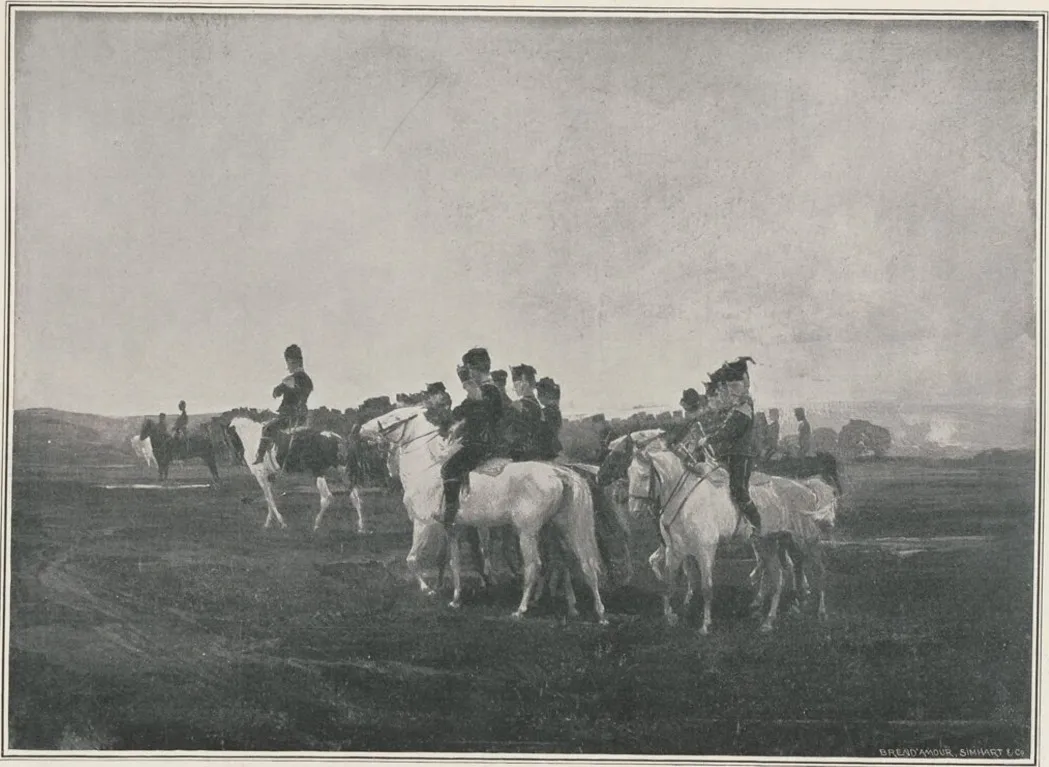
Wilhelm Schreuer, Wartende Husarenkapelle (Hussar Band Waiting), reproduced in Die Rheinlande 1, 1900, no. 3, p. 21. Wilhelm Schäfer called the small oil painting “this exquisite little masterpiece”. Public domain. Scan: Heidelberg University Library
Düsseldorf’s critics were marvelling at this before he was thirty. In November 1894 an art salon showed two grisailles of the manoeuvre in which the 7th Army Corps had crossed the Rhine at Kaiserswerth on 12 September. The Generalanzeiger praised “the astonishing memory, the speed of perception reminiscent of the snapshot photographer” and said that not even the famous French battle painters de Neuville and Detaille had shown soldiers pushing a gun up a slope more truthfully. In February 1895 the same paper wrote of a grisaille of horse artillery by the Rochus chapel that nothing was lost “on the way from the eye to the hand, as Lessing says”.
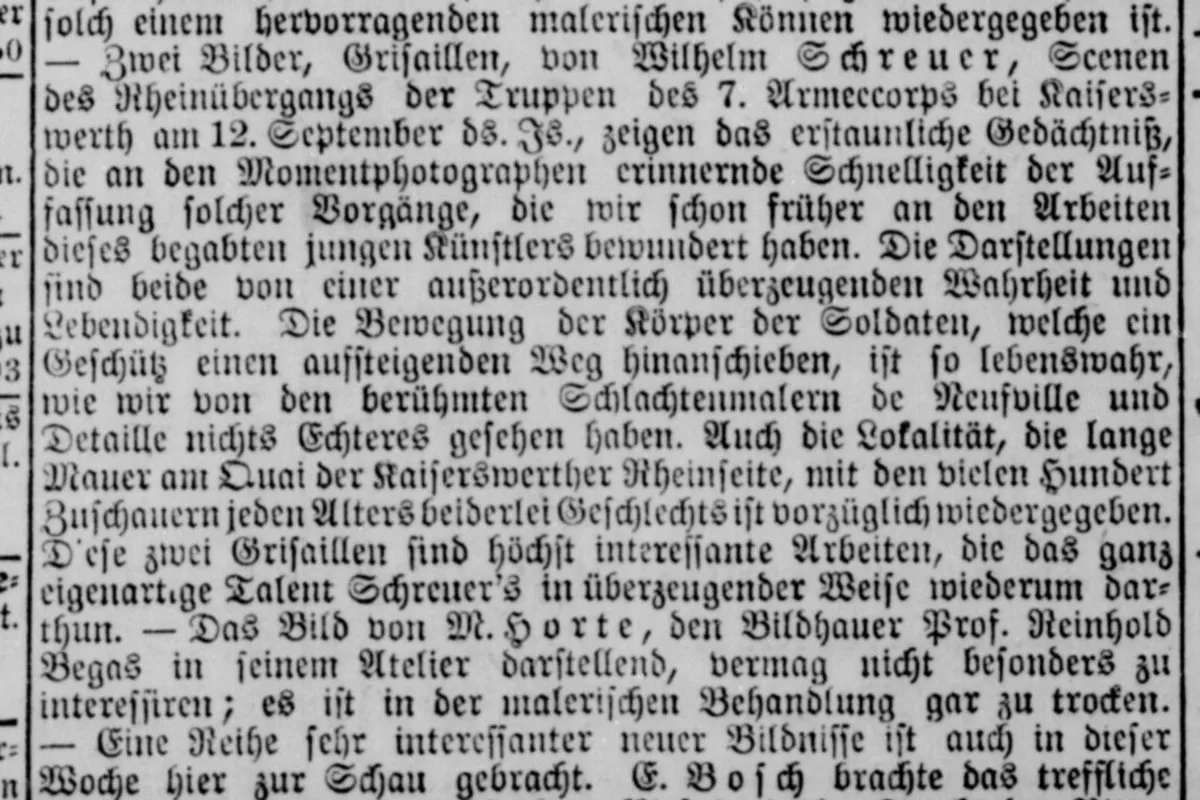
Generalanzeiger für Düsseldorf, 4 November 1894 (detail). One of the two grisailles is probably the picture reproduced in Die Rheinlande in 1900 as “Übergang der Artillerie bei Kaiserswerth” (see below). Public domain. Scan: zeit.punkt NRW, ULB Bonn
The Morgen-Zeitung was still telling a story about it in 1925. Gregor von Bochmann, himself a great painter of horses, had objected that the legs of a galloping horse in one of Schreuer’s pictures were wrong. Schreuer insisted they were right. The two made a bet, and a snapshot photograph was to decide it. The photograph proved Schreuer right: his eye had caught a movement the naked eye does not normally perceive. The paper does not say when this happened, and whether it happened exactly so cannot be checked. That people told the story says a lot about his reputation.
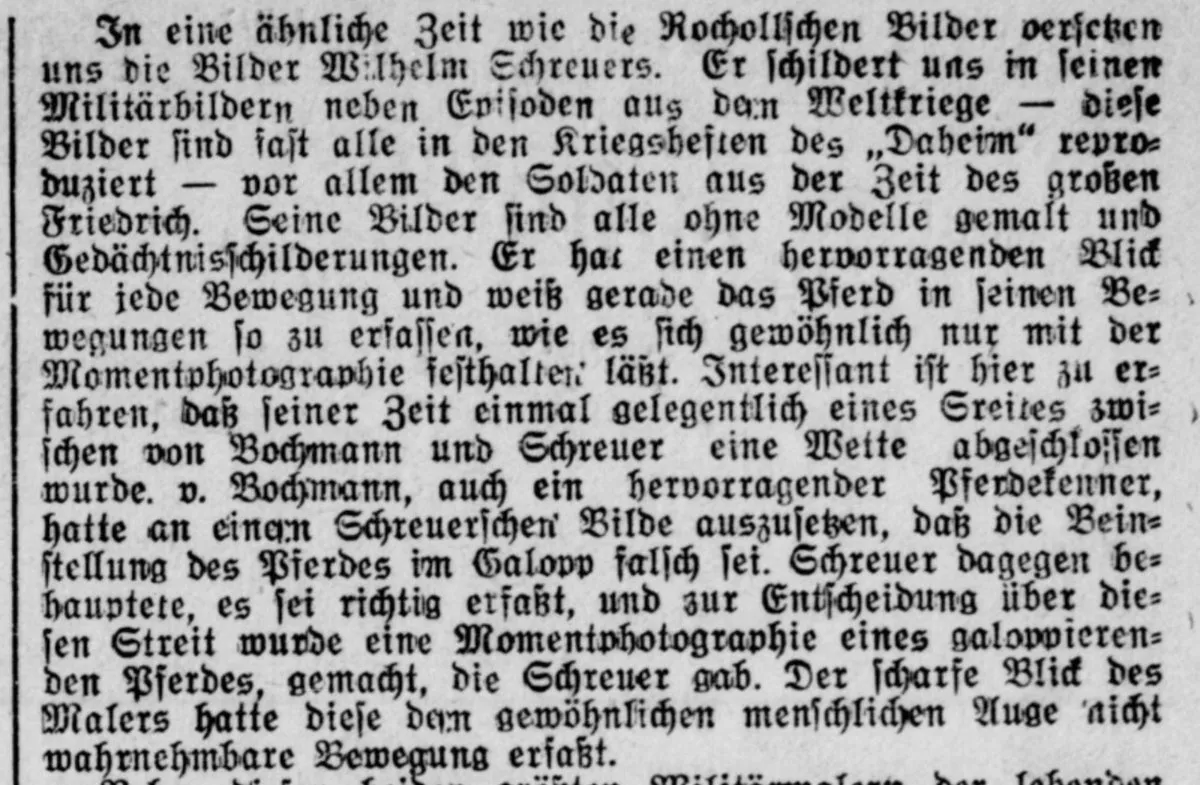
Morgen-Zeitung, 30 August 1925 (detail). Public domain. Scan: zeit.punkt NRW, ULB Bonn
A technique that forgives no mistakes
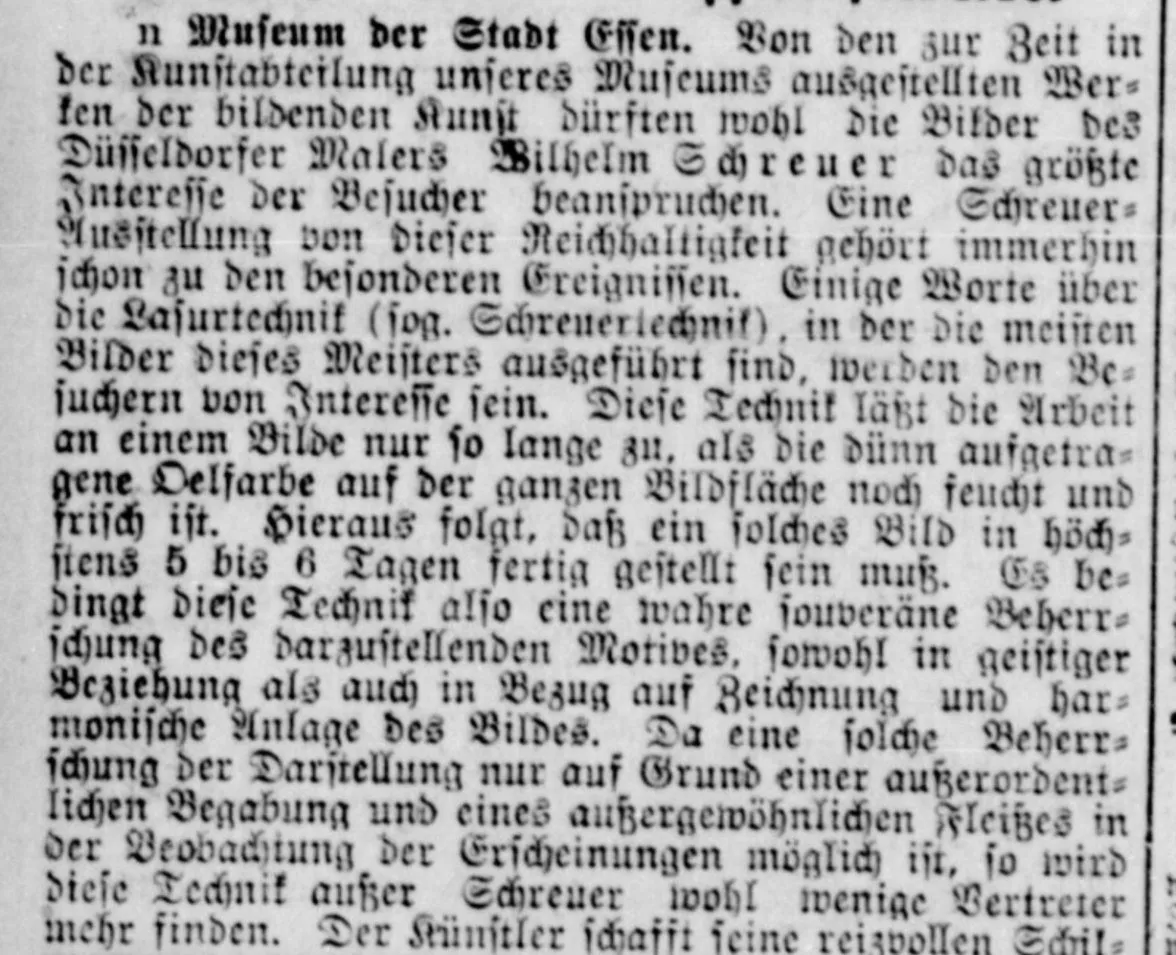
What sets Schreuer’s pictures apart is their technique. Schäfer described it precisely in 1900. Schreuer applied a wet, tonal ground to sized paper. He wiped the highlights out of this ground and painted the shadows on top. This only worked while the ground was wet, so a picture, even a large one with many figures, had to be finished in three or four days. Corrections were hardly possible.
When the municipal museum in Essen held a large Schreuer exhibition in June 1907, the Essener Volks-Zeitung explained the “glazing technique (the so-called Schreuer technique)” to its readers: one could work on a picture only as long as the thinly applied oil paint was still wet and fresh, so it had to be finished in five or six days at most. Few besides Schreuer, the paper thought, would ever take up this technique. In 1926, for his 60th birthday, a critic wrote that he very rarely used a sketch and “never the photographic plate”, and put on paper in a few hours “what his eye saw in a few seconds”.
Essener Volks-Zeitung, 18 June 1907 (detail). Public domain. Scan: zeit.punkt NRW, ULB Bonn
The result is pictures with an almost mirror-smooth surface in which every brushstroke is nevertheless visible, and with a restrained, often almost monochrome palette of brown, green, blue and gold. Schäfer spoke of “chiaroscuro sheets”, Brües in 1933 of a “draughtsman’s Impressionism” that came from Krüger, Schadow and Menzel rather than from France. It had little to do with French Impressionism. Schreuer cared more about light and movement than about colour.
Old Düsseldorf and Napoleon
After the parade ground came the past. Schreuer painted Düsseldorf as it had looked before industrialisation, the gardens, inns and gabled houses of the old town, and peopled them with figures of the eighteenth and early nineteenth centuries. From 1896 Eduard Schulte’s salon showed a whole series of these sepia grisailles, which the press called “snapshots from old and new Düsseldorf”: the towpath on the Rhine, the Ratinger Tor with the Wesel mail coach, the arrival of the first Cossacks, hussars on the Schadowstrasse. In December 1897 ten of them were published as collotypes by the Wilhelm Otto studio in a portfolio from Wörmbcke & Schütze on the Schadowstrasse, at a subscription price of 25 marks. His best-known subject was Napoleon’s visit to Düsseldorf, the capital of his Grand Duchy of Berg, in November 1811. The young Heinrich Heine saw the emperor ride in as a child and later described it. Schreuer painted Einzug Napoleons durch die Ratinger Straße (Napoleon’s Entry along the Ratinger Strasse), the first Cossacks in the town and the Russians crossing the Rhine.
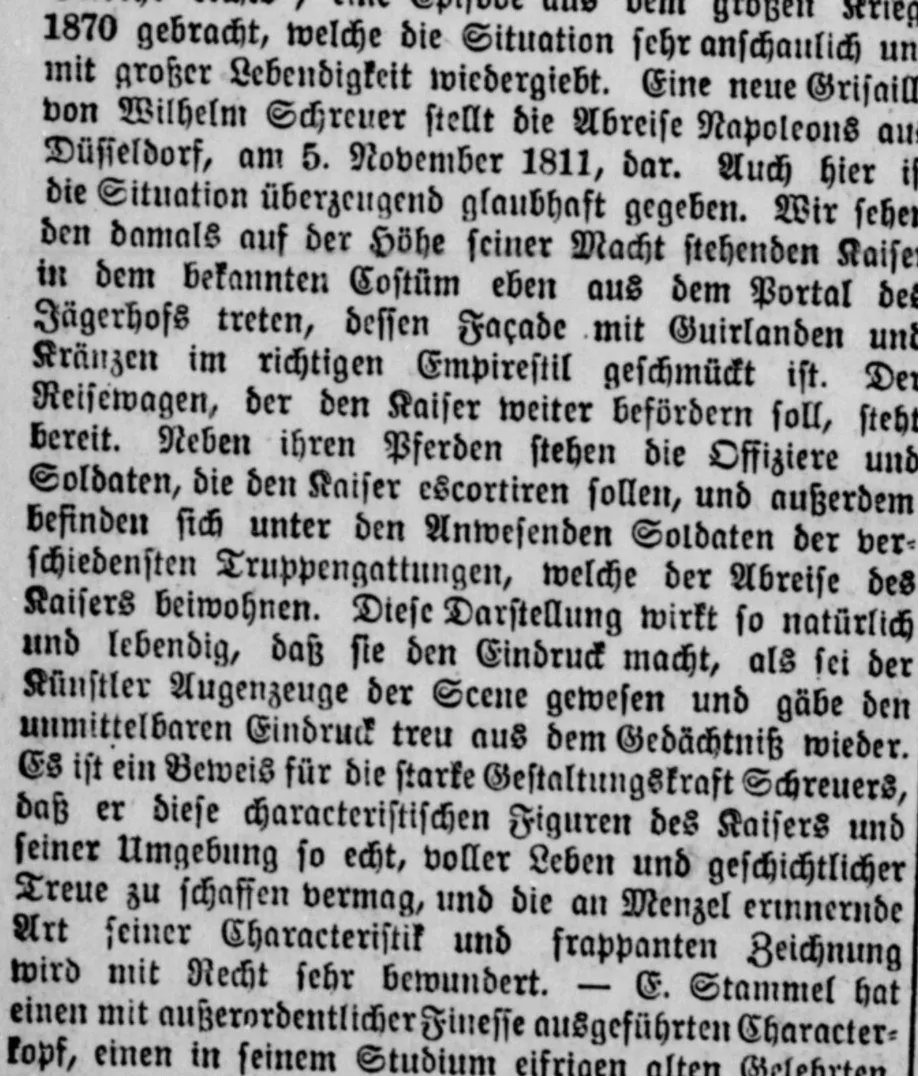
In February 1897 he exhibited Die Abreise Napoleons aus Düsseldorf, am 5. November 1811 (Napoleon’s Departure from Düsseldorf, 5 November 1811): the emperor stepping out of the portal of the Jägerhof, its façade hung with garlands, the travelling carriage waiting, officers and soldiers. The scene looked so natural, the Generalanzeiger wrote, that the artist might have been an eyewitness, and it praised “the Menzel-like manner of his characterisation”. The comparison with Adolph Menzel, the great painter of Frederick the Great, was to follow him all his life. Schreuer painted Napoleon’s entry several times; the largest version, painted around 1901, was owned by the municipal museum in Elberfeld in 1911.
Generalanzeiger für Düsseldorf, 15 February 1897 (detail). Public domain. Scan: zeit.punkt NRW, ULB Bonn
Schäfer was enthusiastic: none of the descriptions by the eyewitness Heine could make the emperor’s ride “as vivid as the art of Wilhelm Schreuer”. But he also saw the danger. Many pictures showed garden parties, promenades and Rococo couples, and Schreuer had sometimes given in to such things too readily, “because he needed money and had to produce something quickly”. Die Kunst für Alle judged similarly around 1900: skilfully done, “but still only illustrations”.
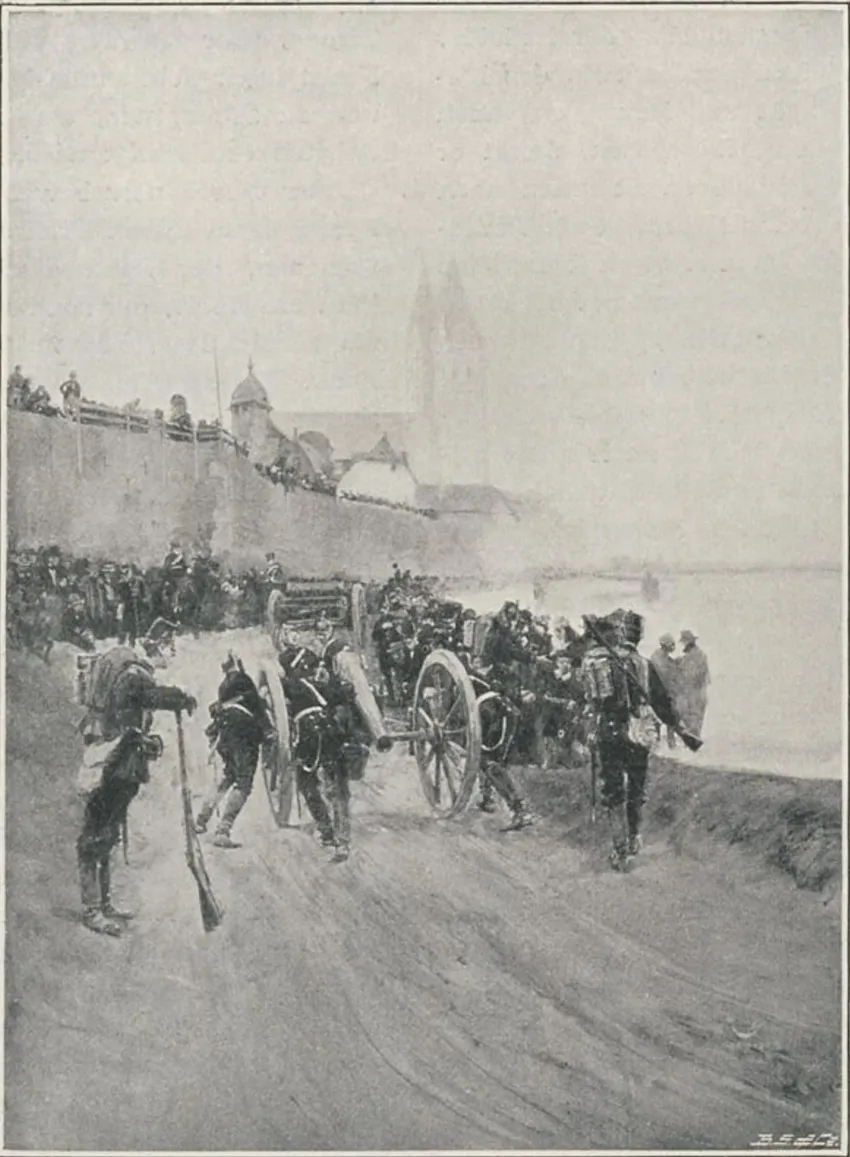
Wilhelm Schreuer, Übergang der Artillerie bei Kaiserswerth (Artillery Crossing at Kaiserswerth), probably 1894, reproduced in Die Rheinlande 1, 1900, no. 3, p. 24. Public domain. Scan: Heidelberg University Library
At the Café Cornelius
Yet Schreuer did not paint only the past. On 13 February 1900 he dated a picture from the Café Cornelius in Düsseldorf: a red carpet filling almost half the canvas, columns, chandeliers, ladies in feathered hats, a waiter with a napkin and, front right, a gentleman in tails absorbed in his newspaper. The painting now belongs to the Stadtmuseum Düsseldorf. The café was new at the time: in April 1900, among his pictures in sepia tones, Schreuer also exhibited an “interior from our new Café Cornelius on the Königsallee”, as the Generalanzeiger wrote; whether it was a study for the oil painting is not known. The oil painting shows what Brües meant when he wrote that Schreuer was at home in every sphere of modern life where it rose to movement: at the fairground, in the riding school, in the street, in the tavern.
Success
Around 1900 Schreuer was a painter in demand. In 1896 he joined the Malkasten, the social centre of Düsseldorf’s artists. In May 1899 he married Maria Pauly, daughter of the art dealer Leo Pauly, whose gallery still owned some of his best pictures in 1926. The couple had ten children, five sons and five daughters. Children appear in many of his pictures too, unselfconscious and sometimes looking bored among the adults. His most important dealer became Eduard Schulte, who also sold his work in Berlin.
At the Paris World’s Fair of 1900 he received an honourable mention, and in the same year he showed with the Free Association of Düsseldorf Artists in the Munich Glaspalast. His greatest success came in 1904: the international jury of the World’s Fair in St. Louis awarded him a gold medal, alongside Franz von Defregger, Ludwig von Löfftz and Anton von Werner.
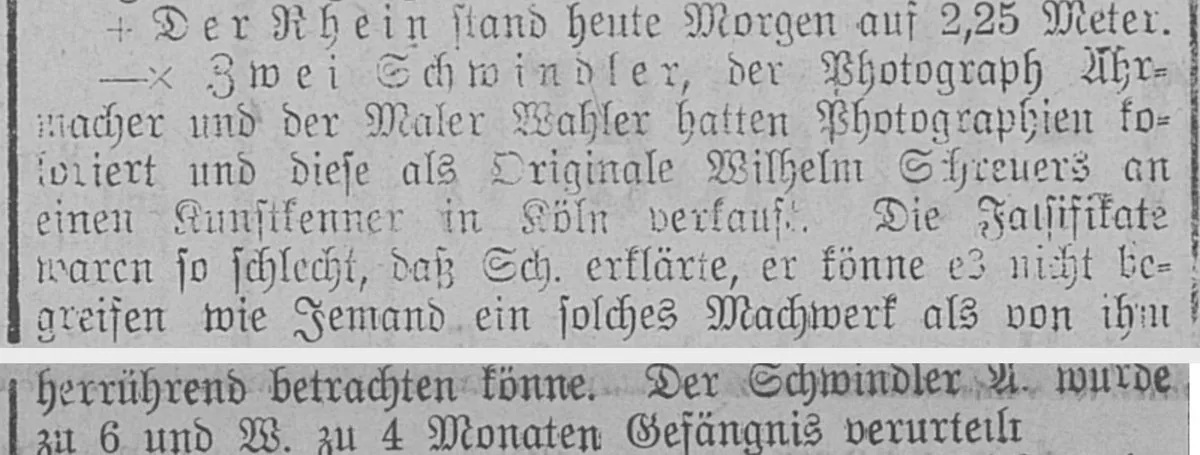
How sought-after his pictures were is shown by a short court report from May 1903. A photographer and a painter had coloured photographs and sold them to a connoisseur in Cologne as original Schreuers. The fakes were so bad that Schreuer declared he could not understand how anyone could take such a botch for his work. The two were sentenced to six and four months in prison.
Düsseldorfer Zeitung, 24 May 1903 (detail; the report continues in the next column). Public domain. Scan: zeit.punkt NRW, ULB Düsseldorf
In 1904 a critic looked at his Rococo picture Goethe bei Jacobi (Goethe Visiting Jacobi) and called him an artist “who, with his fabulous memory for form, almost entirely does without the model”. He added a warning that would often be repeated later: Schreuer risked developing the draughtsman in him at the expense of the painter.
Carnival in Cologne
In 1906 the German Art Exhibition in Cologne showed a whole group of his pictures. Die Kunst für Alle saw his real strength in the “Impressionism of movement”, for instance in a hussar band or in Kölner Karneval, where the carnival procession surges through the old town in sparkling exuberance. The city of Cologne bought exactly this picture for the Wallraf-Richartz-Museum, for 8,800 marks. At the exhibition it was called Der Kölner Karnevalzug im Jahre 1872 (The Cologne Carnival Procession of 1872): so Schreuer painted not a procession of his own day but one from the years when his family moved to Cologne, more than thirty years later. It shows the Rose Monday procession on Cologne’s Marsplatz: dancing guards in red and white, a decorated float, spectators right up to the windows. Today it hangs on loan in the Kölnisches Stadtmuseum.
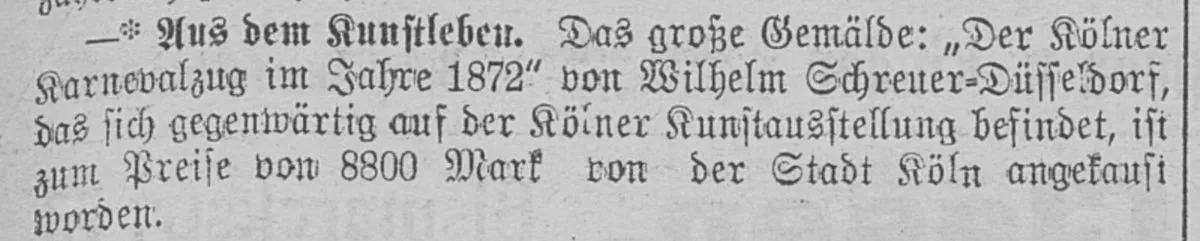
Düsseldorfer Zeitung, 20 May 1906 (detail). Public domain. Scan: zeit.punkt NRW, ULB Düsseldorf
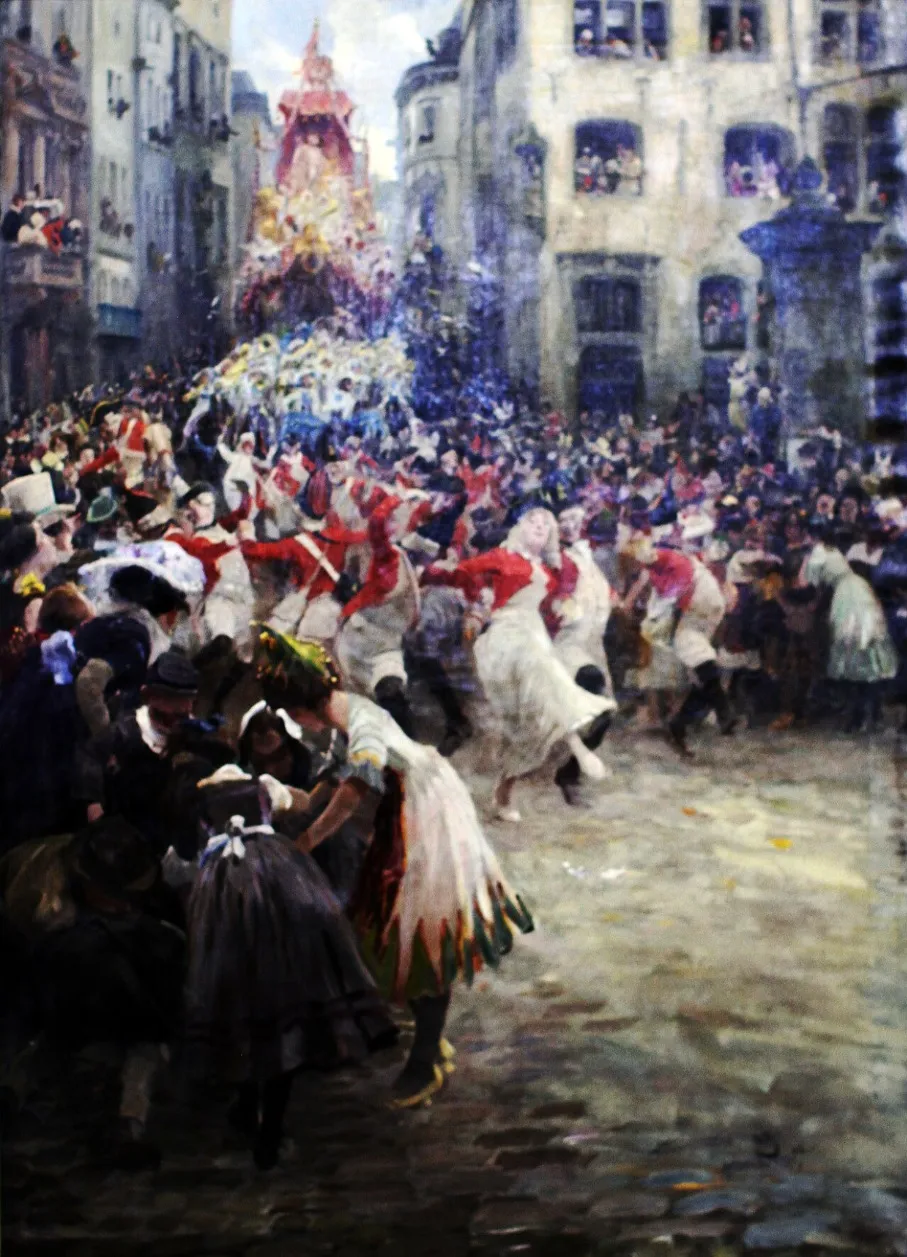
Wilhelm Schreuer, Kölner Rosenmontagszug auf dem Marsplatz (Rose Monday Procession on the Marsplatz in Cologne, acquired in 1906 as Kölner Karneval), oil on canvas, Wallraf-Richartz-Museum, on view in the Kölnisches Stadtmuseum (detail). Public domain. Photo: HOWI, Wikimedia Commons
In December 1906 the Kunstverband Düsseldorf, of which Schreuer was a member, showed his pictures at Schulte’s in Düsseldorf. The Düsseldorfer Generalanzeiger called him “the other star of the Cologne exhibition” beside Gerhard Janssen and praised the small Gartenrestaurant, a cheerful company under shady trees; it had already found a buyer. And when Cologne’s artists held their annual exhibition in 1908, Die Kunst für Alle wrote that with Schreuer one might fairly use the word “genius”.
Also in 1906, the Association of Art Lovers in the Rhine Lands granted funds for a “Wilh. Schreuer-Stiftung”: Schreuer was to paint a series of pictures on the history of Cologne. In June 1907 the municipal museum in Essen gave him a large exhibition. In May 1912 the Kunstverein in the Ruhmeshalle in Barmen showed a group of his pictures at the same time as groups by Gabriele Münter and Wassily Kandinsky, who a few months earlier had come to the fore with the first Blue Rider exhibition in Munich. Two very different ways of painting thus hung under one roof.
In 1913 he represented Düsseldorf at the Hamburg Kunstverein in an exhibition of four German art cities, with views of the Rhine, memories of Italy and Upper Bavaria, orchestra and Rococo scenes. For the centenary of the Wars of Liberation he showed the large picture Aus dem Winter 1813/14 in Düsseldorf (The Winter of 1813/14 in Düsseldorf), troops on the bank of the Rhine, at the Great Art Exhibition in Düsseldorf. The Kölnische Zeitung found it painted “with cold skill”; the jury awarded him the gold medal for art. A few months later the manufacturer Max Jagenberg gave his picture Übergang der Russen über den Rhein bei Düsseldorf im Jahre 1814 (The Russians Crossing the Rhine at Düsseldorf in 1814) to the city’s art collections.
War painter
In the First World War Schreuer went to the front in Belgium and France as a war painter. In March 1915 Die Kunst für Alle devoted an illustrated essay to him. The author, Gustav Opfer, praised his pictures for going “far beyond the bounds of illustration”; carried by the gift of an almost limitless memory for form, he possessed the equipment of the modern war painter.
As early as December 1914 visitors crowded the Kölnischer Kunstverein in front of his “topical pictures” from the battlefields, “from Louvain, from the life of franc-tireurs and soldiers”, as the Kölnische Zeitung reported. The Kunstverein chose his colour lithograph Kölner Landwehr in Laon (Cologne Territorials in Laon) as its annual gift to members. In February 1915 Schulte exhibited his war pictures on Unter den Linden in Berlin, and in April Schreuer was appointed war painter to an army corps and went to Flanders. From his first group exhibition, in Schneider’s gallery in Frankfurt, the Berlin Nationalgalerie bought Trainkolonne in Flandern, and the city of Düsseldorf Im Schützengraben and Angreifende Ulanen (Attacking Uhlans). In 1915 Velhagen & Klasing published the book Kriegsfahrten deutscher Maler with contributions by him.

Düsseldorfer Generalanzeiger, 12 May 1915 (detail). The report also mentions the Napoleon in Elberfeld and the Cologne carnival in the Wallraf-Richartz-Museum. Public domain. Scan: zeit.punkt NRW, ULB Bonn
The pictures bear titles such as Aufklärung an der Yser (Reconnaissance on the Yser), Im Schützengraben (In the Trench), Trainkolonne in Flandern (Supply Column in Flanders), Niederrheinische Landwehr in Laon (Lower Rhine Territorials in Laon) and Straßenkampf in Löwen (Street Fighting in Louvain). That last picture has to be seen differently today than in 1915. In Louvain, in August 1914, German troops killed some 250 civilians and set fire to the famous university library; German propaganda spoke of fighting against irregulars. Schreuer’s war pictures belong to this world of images. Today the quiet ones among them are the most affecting.
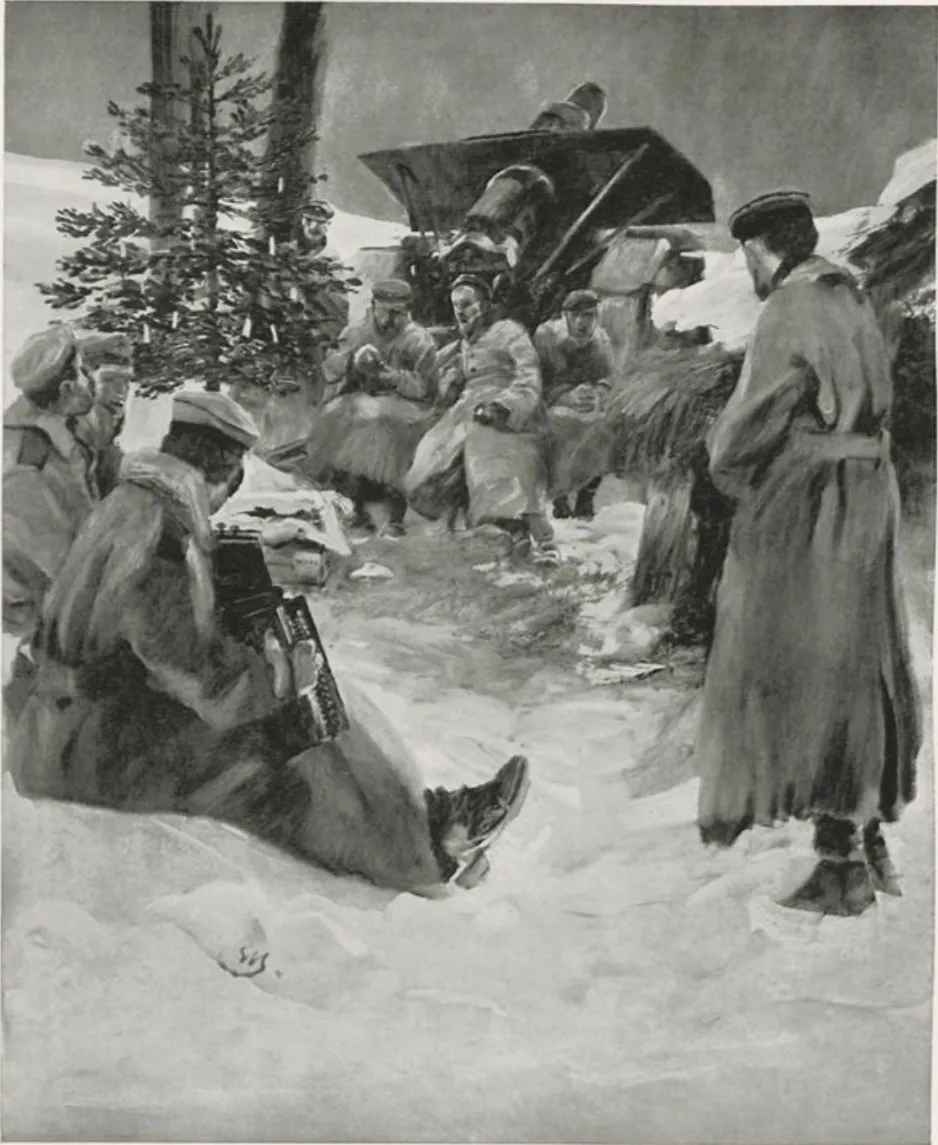
Wilhelm Schreuer, Weihnachten im Felde (Christmas in the Field), reproduced in Die Kunst für Alle 30, 1914/15, p. 233. Public domain. Photo: C. Luck, Düsseldorf. Scan: Heidelberg University Library
In 1916 he showed a picture of the fighting at Zonnebeke in Flanders at the Great Berlin Art Exhibition. At the exhibition of war pictures at the Berlin Academy the same year, Die Kunst für Alle placed him “at the head” of the painting reporters for the easy, assured elegance of his handling. Deeper experiences, the critic added, Schreuer did not convey.
Later years
After the war Schreuer went on painting much as before: farmyards, ferry houses, railway platforms, interiors with ladies in crinolines. He showed at the big exhibitions in Düsseldorf and Cologne into the 1920s. For his 60th birthday in 1926 the Dom-Galerie in Cologne held an exhibition of his pictures, and the Düsseldorfer Stadt-Anzeiger listed his best-known works once more: Napoleon’s entry, the arrival of the first Cossacks, tow-boat traffic on the Rhine, the interior Magdalena with two women in conversation, Trio and Im Vorzimmer (In the Anteroom). State and municipal museums had bought his pictures, the paper noted, including the Düsseldorf Kunsthalle.
By then the critics had long been divided. As early as 1918 a Düsseldorf reviewer had written that the “mass production” into which his easy way of working had at times led him had done him great harm. In May 1926 the art historian Walter Bombe called him “the Düsseldorf Menzel” in Velhagen & Klasings Monatshefte. In October 1926 the Düsseldorf Kunsthalle held a special show for his 60th birthday, and the Kölnische Zeitung called him “the painter of the art salons”: there was hardly a dealer in Düsseldorf or Berlin without a few Schreuers to hand. Fragments of his work were of enchanting grace, the paper said, but the whole was smooth and made again and again to the same recipe.
An anecdote fits this abundance. It appeared in the Düsseldorf paper Der Mittag in 1929 and again in the Gladbach-Rheydter Tageblatt in 1934, told by a lawyer from a town not far from Düsseldorf. When he wanted to buy a picture, Schreuer sent him to his brother-in-law: he could paint the pictures, his brother-in-law could sell them. And then: “I paint four grades of pictures, according to what the buyers pay: A, B, C and D.” The visitor asked for a picture of grade A at the price of grade D. Nothing doing, Schreuer replied, he had nine children. Whether he meant it seriously the story does not say. In 1928 his picture Musizierende Gesellschaft (Musical Company) fetched 4,200 marks at auction.
The end
Wilhelm Schreuer died on Saturday, 11 November 1933, in Düsseldorf, aged 67. Two days later the Kölnische Zeitung published an obituary by Otto Brües. It describes a man who, in his studio or at the regulars’ table, looked like a comfortable burgher from the old town around the Jan Wellem monument: bald, round head, a little moustache under the nose, a goatee on the chin, full of mischief. Brües saw him as a painter who had brought movement back into the stiffened tradition of Düsseldorf history painting, and closed by calling him “one of the last Düsseldorf painters of the old school”.
The same day the Düsseldorf paper Der Mittag recalled how much a matter of course Schreuer had been before the war: “far into very broad sections of the public” it had been “almost good form to own a ‘Schreuer’”. But it could not be passed over, the paper added, that success and his easy hand had at times tempted him into overproduction.
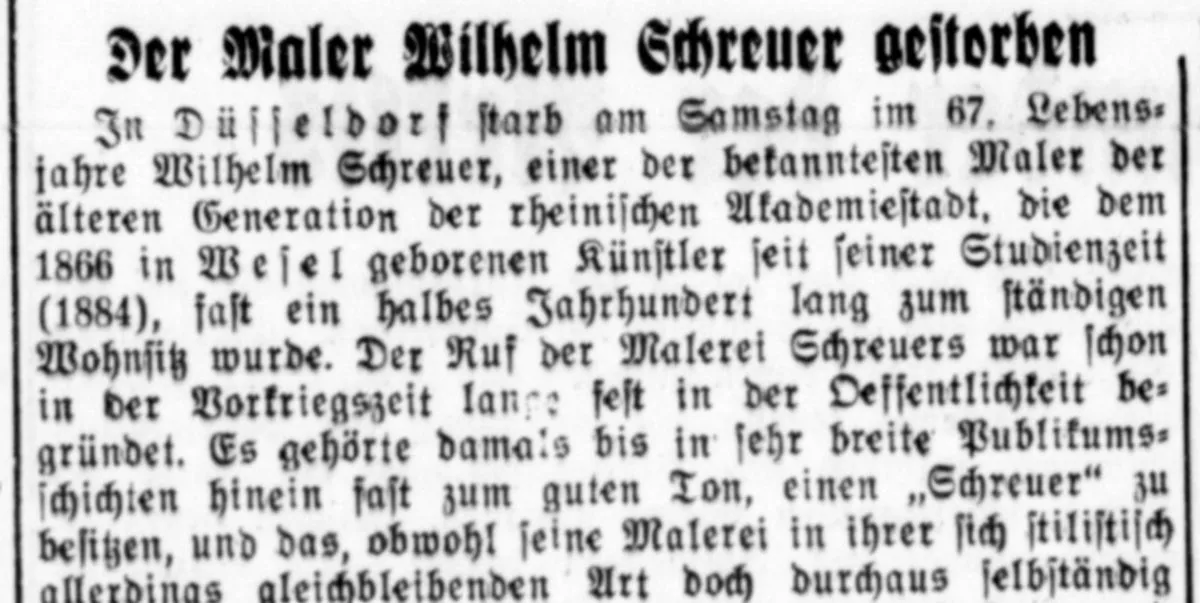
Der Mittag, Düsseldorf, 13 November 1933 (detail). Public domain. Scan: zeit.punkt NRW, ULB Bonn
In March 1934 the Kunstverein für die Rheinlande und Westfalen opened a memorial exhibition with pictures from museums and private collections. The Gladbach-Rheydter Tageblatt took up the old comparison and called him “the Rhenish Menzel”; the Dortmunder Zeitung disagreed: Menzel had been a documentary chronicler of Prussian history, Schreuer rather a popular storyteller who “chatted his way merrily” through history. In the Gladbach-Rheydter Tageblatt a collector quoted the marine painter Andreas Dirks, with whom Wilhelm Schäfer had introduced Schreuer in 1900: “What would Düsseldorf be as a city of art without Wilhelm Schreuer!”
Why he deserves rediscovery
Wilhelm Schreuer stands between two eras. He was no innovator like the painters of the Sonderbund who, a few years later, pushed modernism through in Düsseldorf and Cologne. But nor was he a mere imitator of the old Düsseldorf School. He invented a technique of his own, a risky one, and used it to paint movement and light like hardly any other Düsseldorf painter of his day.
Today his pictures are found mainly on the art market and in the city museums of Düsseldorf and Cologne. A monograph on him appeared in 1997. Anyone standing in front of Im Café Cornelius or the Rosenmontagszug sees a painter who captured the life of his city with astonishing lightness.
Sources and literature
- Wilhelm Schäfer: Zwei Düsseldorfer Maler (Andreas Dirks und Wilhelm Schreuer). In: Die Rheinlande 1 (1900/01), no. 3, pp. 16–26, with Schreuer’s letter of October 1891 (Heidelberg University Library)
- Die Kunst für Alle 15 (1899/1900), 16 (1900/01), 18 (1902/03), 19 (1903/04), 20 (1904/05), 21 (1905/06), 22 (1906/07), 23 (1907/08), 24 (1908/09), 25 (1909/10), 26 (1910/11), 30 (1914/15), 31 (1915/16), 34 (1918/19) (Heidelberg University Library)
- Gustav Opfer: Wilhelm Schreuers Kriegsbilder. In: Die Kunst für Alle 30 (1914/15), pp. 230–236
- Generalanzeiger für Düsseldorf, 4 November 1894, 3 February 1895, 15 February 1897, 5 April 1900, 9 August 1904
- Düsseldorfer Volksblatt, 30 December 1897 (portfolio of collotypes)
- Düsseldorfer Zeitung, 24 May 1903 (forgeries), 20 May 1906 (purchase by the city of Cologne), 6 November 1913 (gold medal)
- Düsseldorfer Zeitung and Echo der Gegenwart, 13 December 1904 (St. Louis awards)
- Düsseldorfer Generalanzeiger, 9 and 11 December 1906 (exhibition of the Kunstverband Düsseldorf); 2 November 1911; 4 February 1914 (Jagenberg gift); 12 May 1915 (Nationalgalerie)
- Essener Volks-Zeitung, 18 June 1907
- Barmer Zeitung, 11 May 1912
- Kölnische Zeitung, 11 May 1913, 11 December 1914, 15 and 24 April 1915, 26 October 1926
- Düsseldorfer Nachrichten, 31 July 1918
- Bonner Zeitung, 28 September 1916
- Morgen-Zeitung, 30 August 1925 (bet with Bochmann)
- Lüdenscheider General-Anzeiger, 3 May 1926 (Walter Bombe: Der Düsseldorfer Menzel, in Velhagen & Klasings Monatshefte, May 1926)
- Rheinische Tageszeitung, 3 and 24 October 1926
- Warendorfer Tageblatt, 2 April 1928 (auction prices)
- Der Mittag, 19 May 1929 and 13 November 1933 (obituary); Gladbach-Rheydter Tageblatt, 19 February, 20 March and 16 April 1934; Dortmunder Zeitung, 18 March 1934
- Düsseldorfer Stadt-Anzeiger, 29 September 1926: “Wilhelm Schreuer 60 Jahre alt”
- Rheinische Tageszeitung, 30 September 1926; Rheinische Volkswacht, 29 September 1926
- Otto Brües: Ein Meister Alt-Düsseldorfs. Wilhelm Schreuer gestorben. In: Kölnische Zeitung, 13 November 1933, evening edition
- News agency report of his death, e.g. Rhein- und Ruhrzeitung, 14 November 1933
- Newspaper portal zeit.punkt NRW (ULB Bonn, Düsseldorf, Münster)
- Verzeichnis der Gemälde des Wallraf-Richartz-Museums der Stadt Cöln, 1910, p. 319
- Thieme-Becker: Allgemeines Lexikon der Bildenden Künstler, vol. 30, p. 286 (not consulted)
- O. W. Höllig, Wilhelm Körs: Wilhelm Schreuer. Ein Düsseldorfer Maler der guten alten Zeit, Düsseldorf 1997 (not consulted)
- Hans Paffrath (ed.): Lexikon der Düsseldorfer Malerschule 1819–1918, vol. 3, Munich 1998 (not consulted)
- Silke Köhn: Wilhelm Schreuer (1866 Wesel–1933 Düsseldorf). In: Sammler Journal, December 2006, pp. 62–69 (not consulted)
- Wikipedia (German): Wilhelm Schreuer; Wikimedia Commons: Category:Wilhelm Schreuer