Foaming, the water plunges over the edge of the weir. The spray is laid on so thickly that you can almost hear the roar. In the shade of a mighty tree stands a young woman. She holds her head bowed. One hand rests at her breast, as if holding the light fabric of her dress together; the other lies at her waist. There is grace in this pose, but also something withdrawn. Perhaps her thoughts are with someone. The picture keeps it to itself. All around her is movement: the water foams and glitters, and through the leaves the last rays of the afternoon sun play golden on the hem of her dress. She alone remains still, lost in thought. Carl Piepho painted this scene around 1903/04, and his model was probably his wife Barbara. For a moment, time seems to stand still. And yet hardly any picture by Piepho has seen as much as this one: Frankfurt, Munich, Venice, Barcelona.
A picture for the great stages
Perhaps the journey begins in Frankfurt, Piepho’s home town. He exhibits at the Kunstverein there several times, and on one occasion a critic singles out a figure of his, “white on a green, landscape ground”. Whether that was Am Wehr cannot be said for certain.
What is documented is its first major appearance in Munich, and it is quite an occasion. On 31 May 1904 Prince Regent Luitpold opens the first exhibition of the Deutscher Künstlerbund in the exhibition building on Königsplatz. The Deutscher Künstlerbund, founded in Weimar only at the end of 1903, aims to bring together modern art from all over Germany. Piepho, by now a member of the committee of the Munich Secession, chooses Am Wehr for the event. The picture hangs in Room 3, and the catalogue gives it a plate of its own. The magazine Die Kunst für Alle reproduces it in its review as well. It is an honour that by no means every exhibitor receives. The critics take notice too. The Heidelberger Zeitung calls Am Wehr a “virtuosically painted waterfall”. And when Piepho shows a different picture at the Heidelberg Kunstverein a few days later, the paper returns to it once more: in Munich, it writes, he had “captured the speed of the water rushing over a weir”.
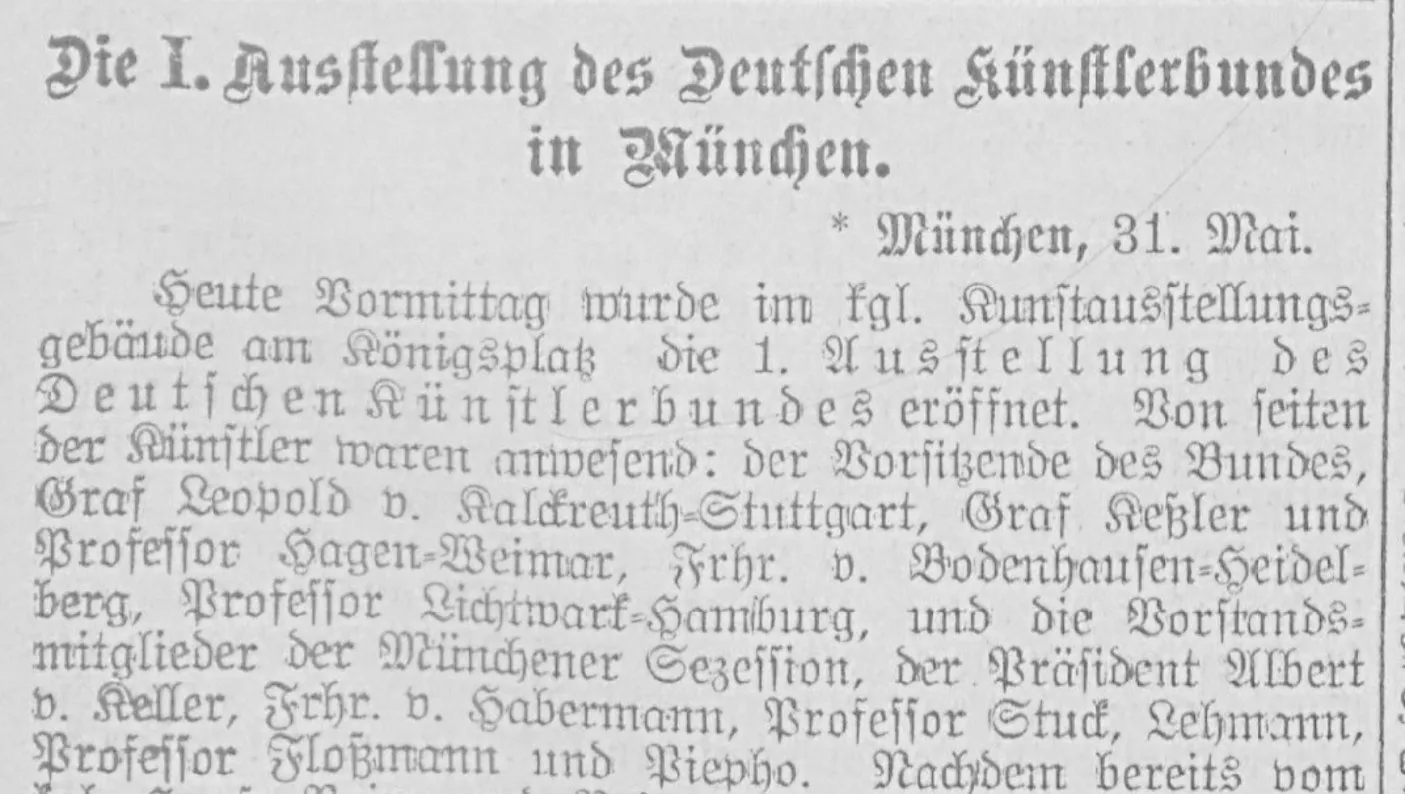
Report on the opening in the Allgemeine Zeitung, Munich, 1 June 1904. Among those present: Piepho. Public domain. Scan: Bayerische Staatsbibliothek, digiPress
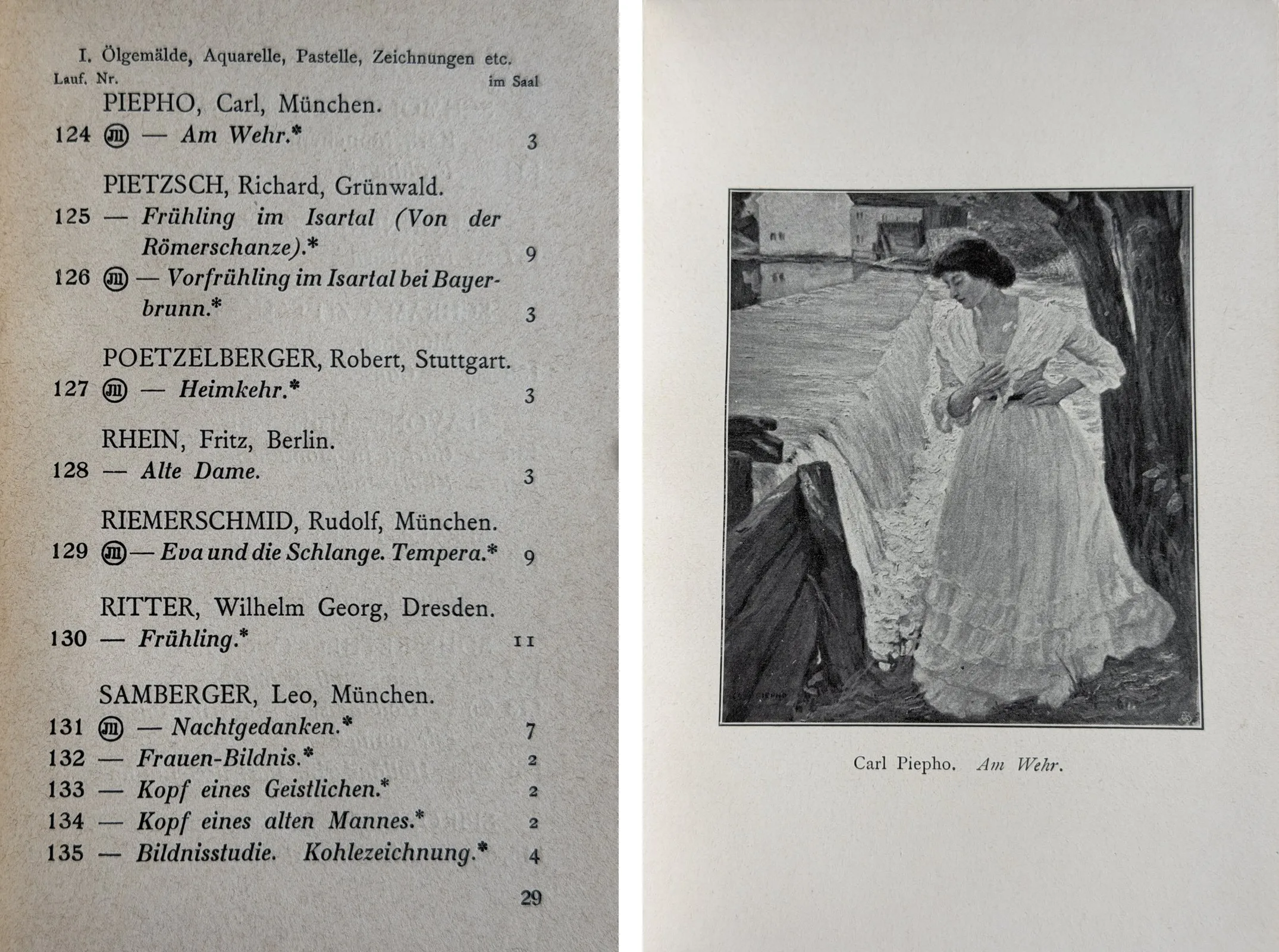
Catalogue of the 10th exhibition of the Munich Secession – Der Deutsche Künstlerbund, Munich 1904: p. 29 with no. 124 and the plate. Public domain. Photos: private
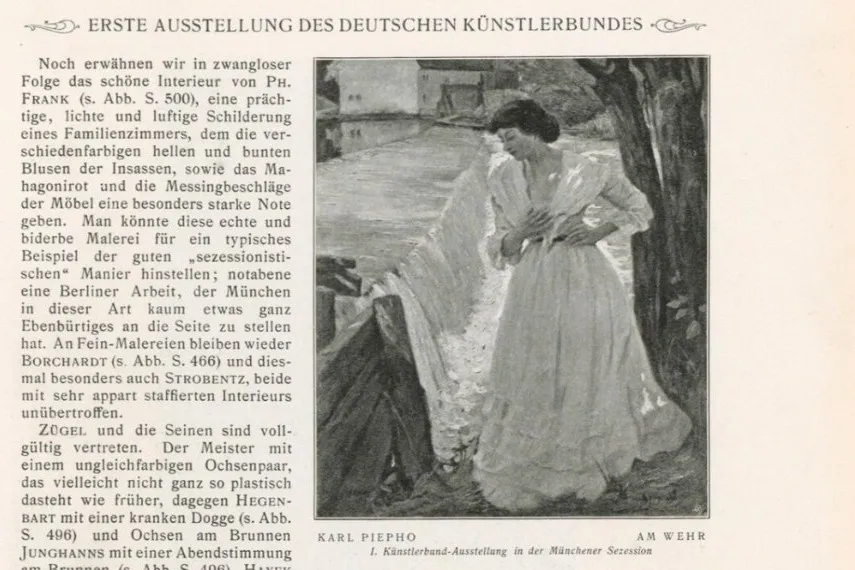
Die Kunst für Alle 19, 1903/04, p. 487. Public domain. Scan: Heidelberg University Library
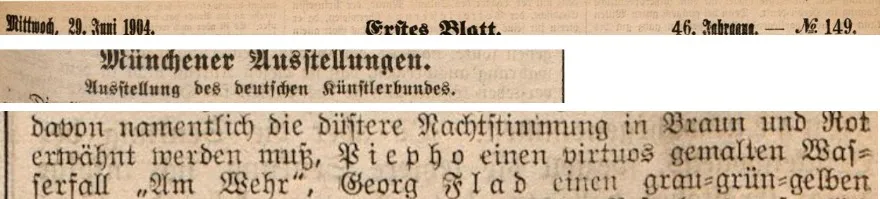
Heidelberger Zeitung, 29 June 1904, review of the Künstlerbund exhibition (excerpt). Public domain. Scan: Heidelberg University Library
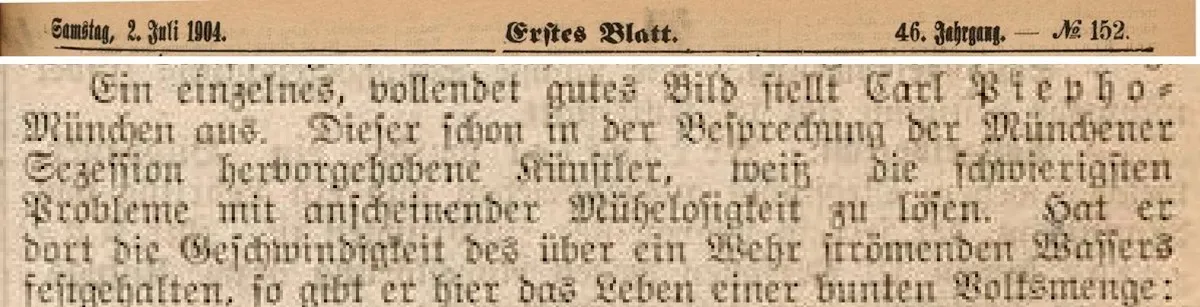
Heidelberger Zeitung, 2 July 1904, review of the Heidelberg Kunstverein (excerpt). Public domain. Scan: Heidelberg University Library
In 1905 the journey continues across the Alps. In Venice, at the International Art Exhibition, today’s Biennale, the picture receives an Italian name: Sull’argine, “On the embankment”. Again the catalogue reproduces it as a plate, facing La schiava by the Sevillian painter Gonzalo Bilbao. And it gets noticed: the art magazine The International Studio counts On the Bank, as it is called in English, among the German paintings “well worthy of notice”, alongside Albert von Keller and Otto Modersohn. One title, three languages: Am Wehr, Sull’argine, On the Bank.
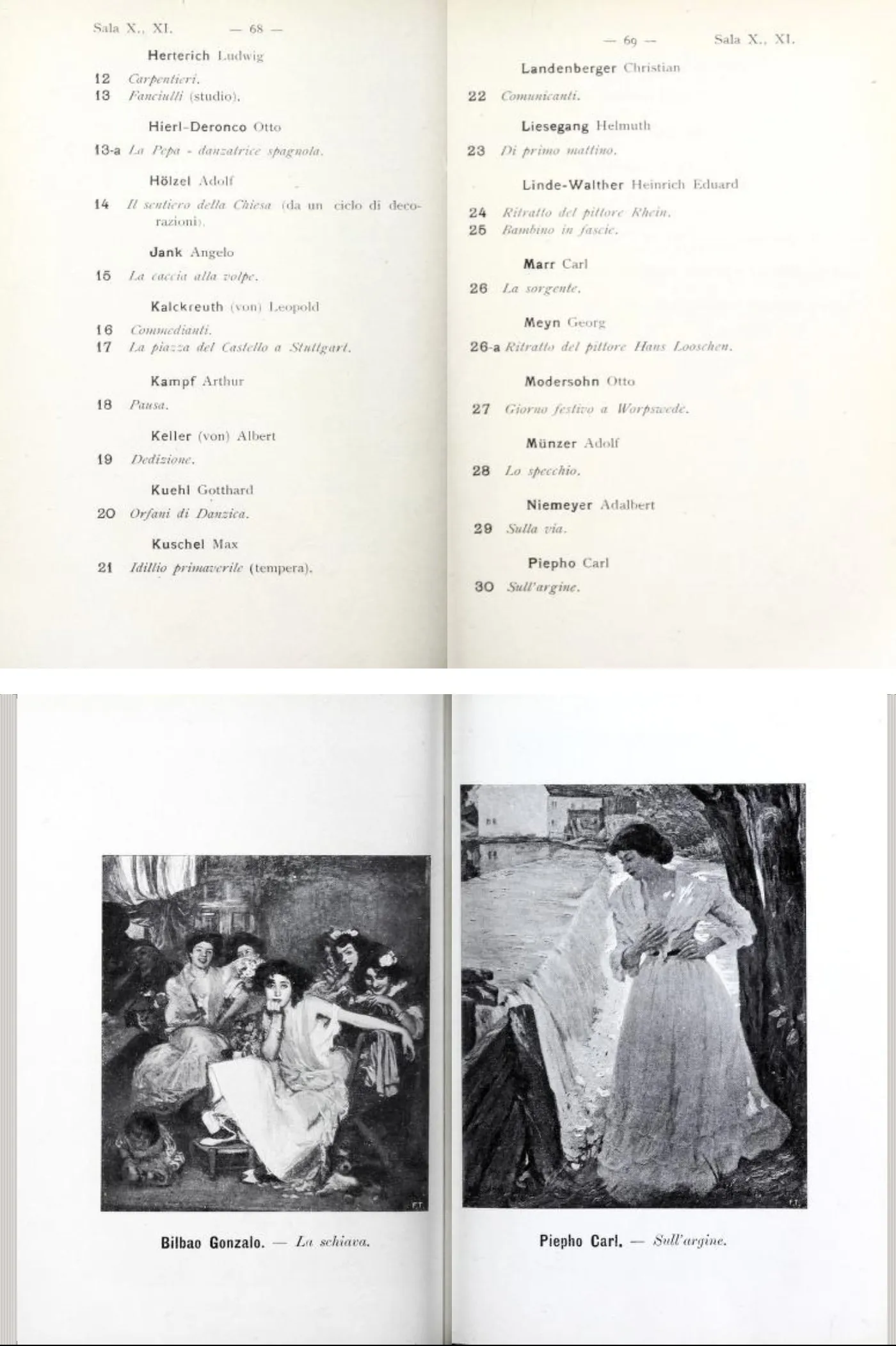
Catalogo illustrato of the VI Esposizione Internazionale d'Arte della Città di Venezia, 1905: list pp. 68–69 and plate. Public domain. Photos: private
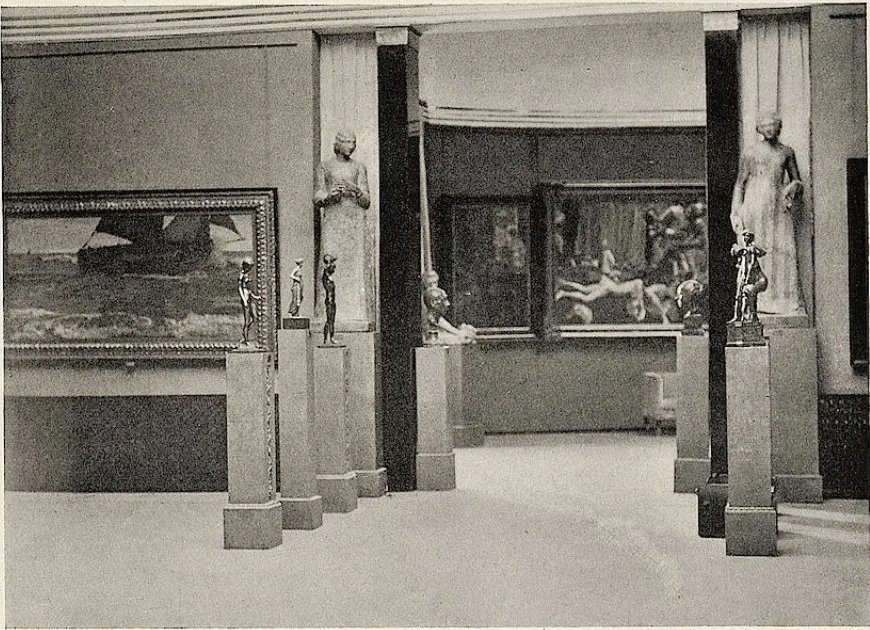
The German section of the 1905 Biennale, where Am Wehr was also on show. From The International Studio 26, 1905, p. 222 (“German Room, Venice Exhibition”). Public domain. Scan: Heidelberg University Library
Two years later, in 1907, it has reached the Mediterranean. At the International Art Exhibition in Barcelona it hangs in Room XXVIII among works by German colleagues, now as Sobre el Wehr. The catalogue gives a price: 2,500 pesetas. Whether a buyer was found, no source tells us.
A Secession painter in those years exhibited constantly, and what went on tour was usually whatever had just left the studio. Piepho, however, relied on this one picture for years and in several countries. It was precisely where the critics and an international public were waiting that he sent the woman at the weir. It was his showpiece, perhaps the work in which he recognised himself best. And in all likelihood it showed the person closest to him.
The motif never let him go. In December 1913 the Graphische Sammlung in Munich acquires a drawing of his, simply titled Wehr (Weir). When the Kunstverein shows his estate in 1921, a year after his death, the critic singles out precisely this sheet. Of the painting there is no longer any mention. Its trail fades.
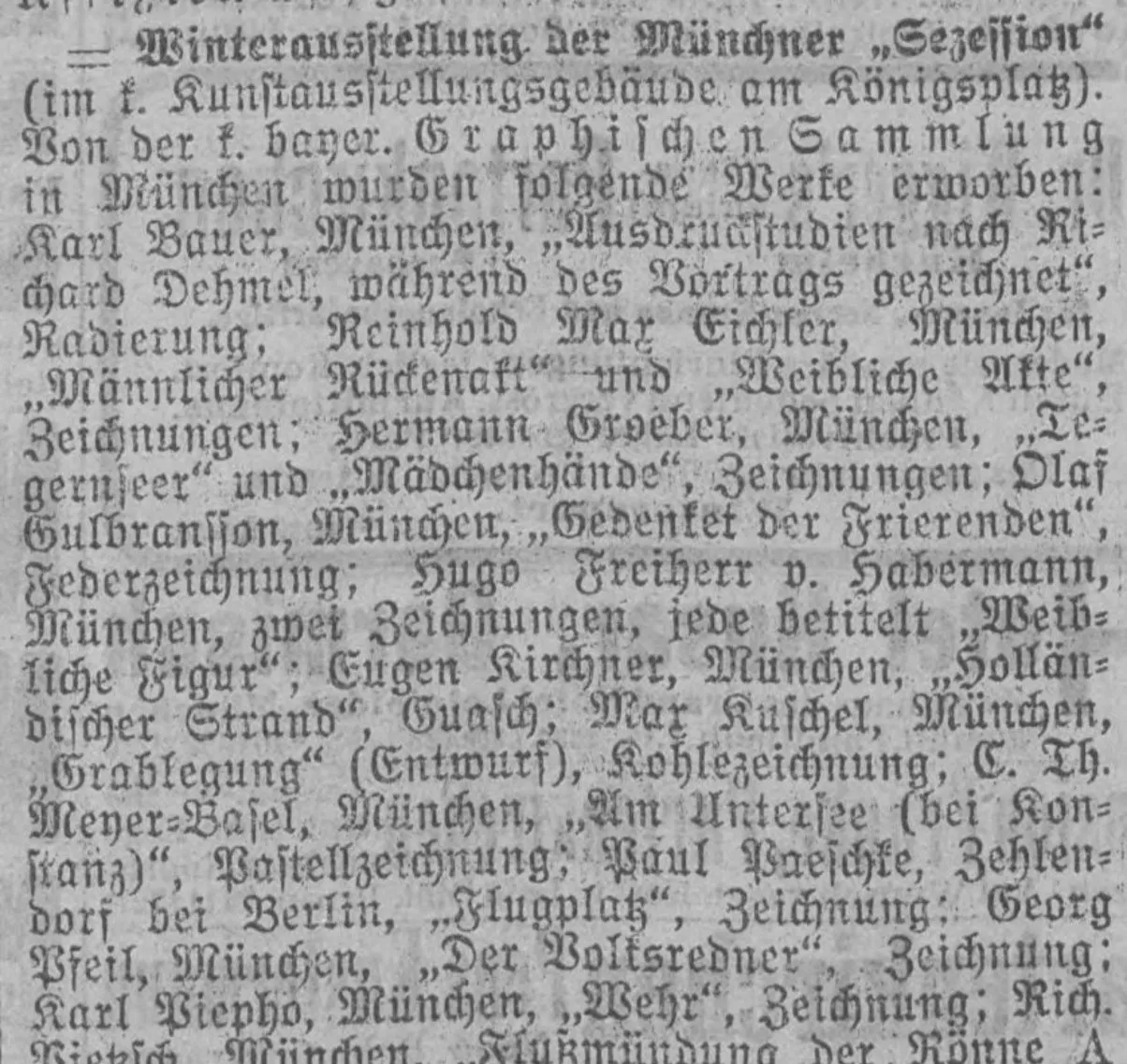
Münchner Neueste Nachrichten, 14 December 1913: the Graphische Sammlung acquires Piepho’s drawing “Wehr”. Public domain. Scan: Bayerische Staatsbibliothek, digiPress
A hundred years of silence
About the century that followed, the sources are silent. The picture must have hung somewhere, perhaps in living rooms whose occupants had no idea of Venice and Barcelona. With the picture, its painter too slipped into oblivion. Piepho’s works scattered into private hands; hardly any found their way into a museum.
A phone call in July
At the beginning of July 2026 the phone rings at the home of the painting’s present owner. On the line is the art researcher Barbara Hofkamp. The two talk about this and that, and almost in passing she mentions a listing she has come across in her research: a painting by Carl Piepho is up for sale. She knows which picture she is looking at. It is the woman at the weir, who once hung in Munich, Venice and Barcelona and then disappeared from the art market for more than a hundred years.
While they are still on the phone, he pulls up the listing online. The woman in the pale dress, the foaming water, the evening light: even the photo will not let him go, and before he hangs up he knows he has to see this picture with his own eyes. He contacts the seller and drives to see her. In front of the original, he is lost for good. What still looked flat in the photo comes alive here: the thick paint of the spray, the shimmer in the dress, the warmth of the light. He does not hesitate for a moment and buys the picture on the spot.
After that, the story falls into place piece by piece. In the Künstlerbund catalogue of 1904 stands this very woman at this very weir. In the Biennale catalogue of 1905 she appears again under an Italian name, and the Barcelona list supplies the Spanish one.
At the conservation centre
In the autumn the Restaurierungszentrum, the conservation centre of the city of Düsseldorf, takes on the picture. The conservator examines canvas, ground and paint layer, and the findings are good news: painting and frame are stable. Above all, no one has ever lined the picture onto a second canvas. It is still exactly the fabric that Piepho painted and that travelled through Munich, Venice and Barcelona. Up close you can follow how he worked. The dark areas are painted so thinly that the weave shows through. The dress and the spray, by contrast, he built up in strong, thick strokes. Over this lies a warm, orange-yellow sheen. Whether Piepho applied it himself as a glaze or whether it is aged varnish, the examination cannot yet say for certain.
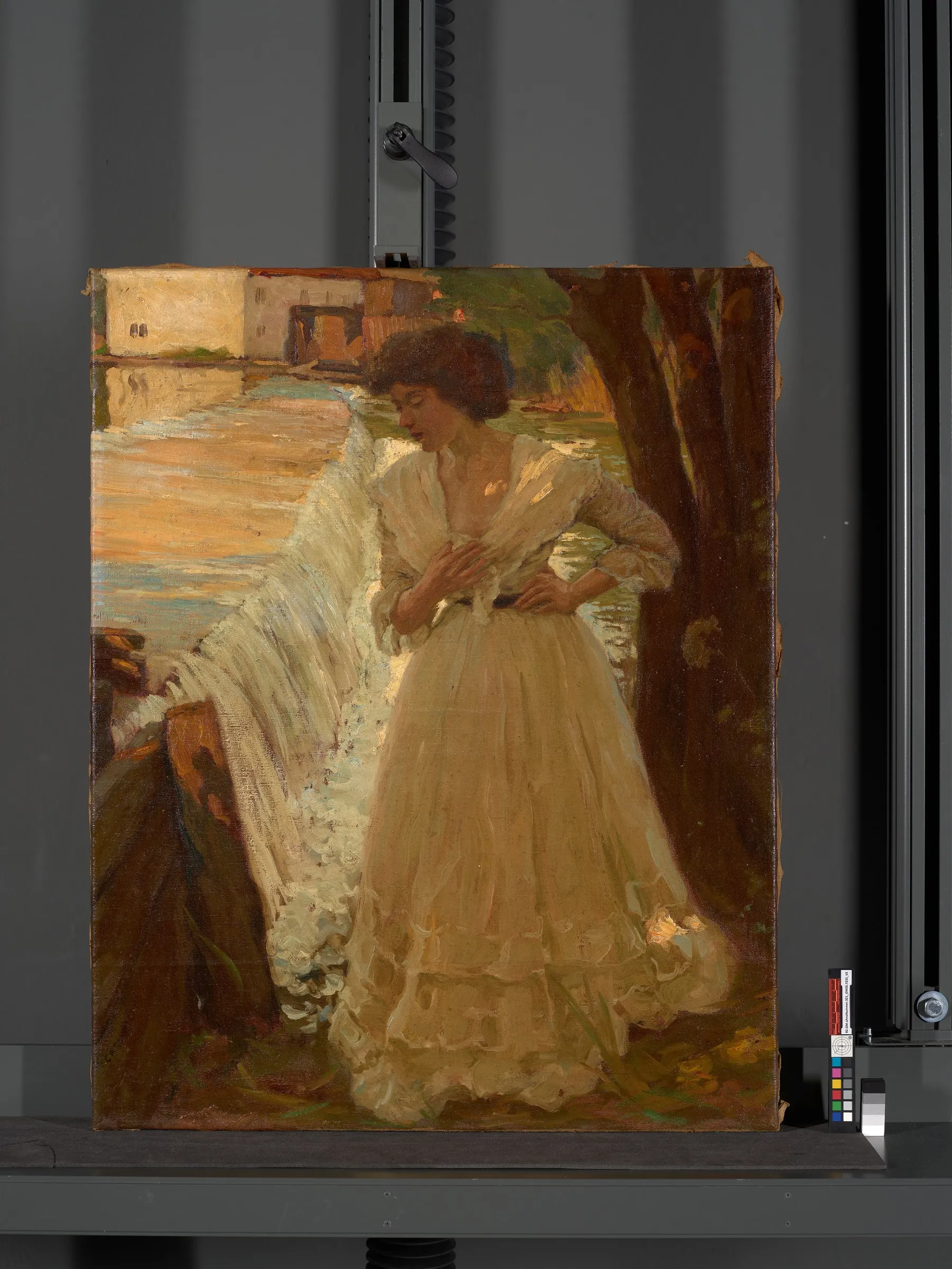
Am Wehr unframed during the condition survey at the Restaurierungszentrum Düsseldorf, 2026. Public domain. Photo: Restaurierungszentrum Düsseldorf
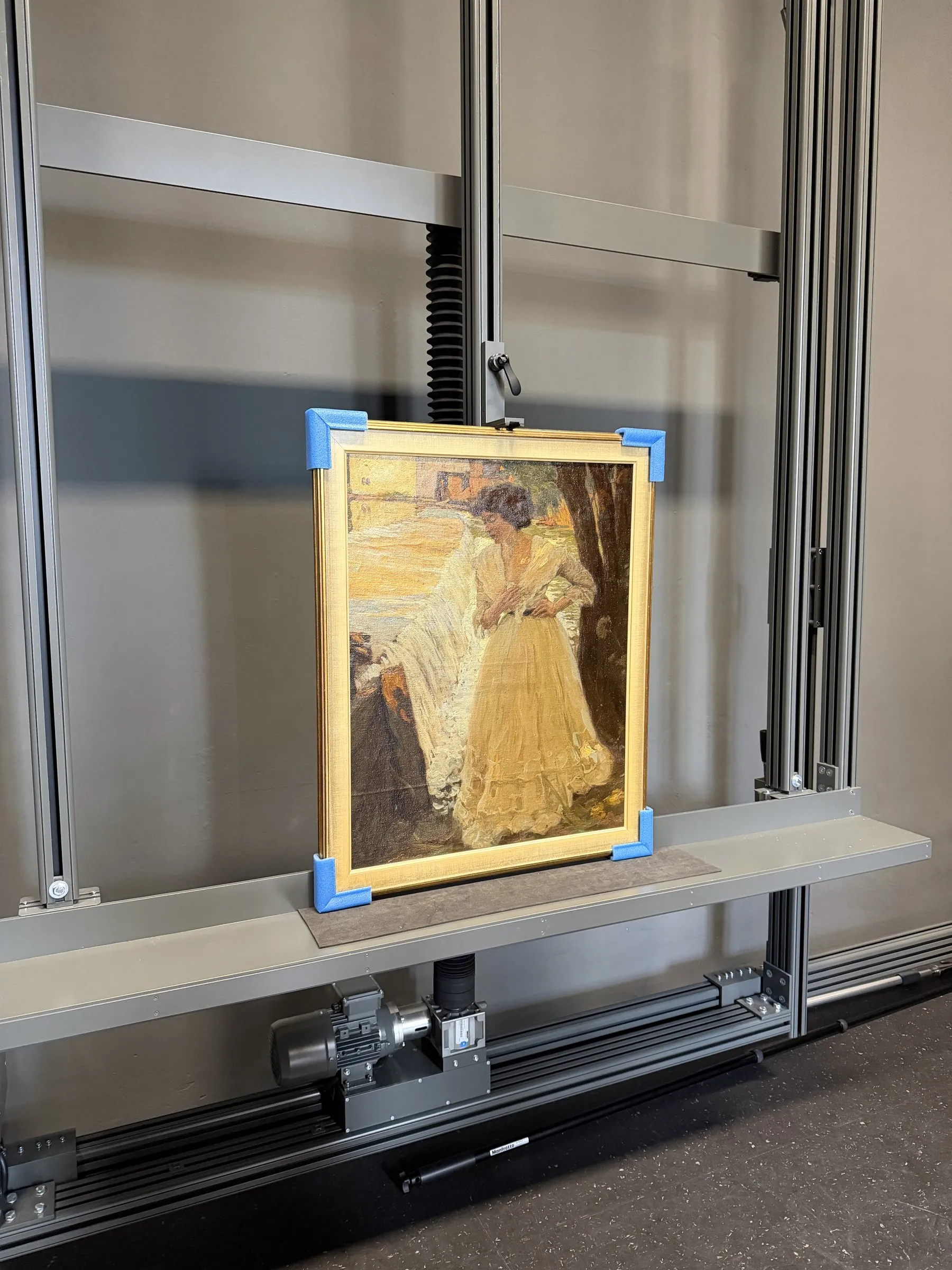
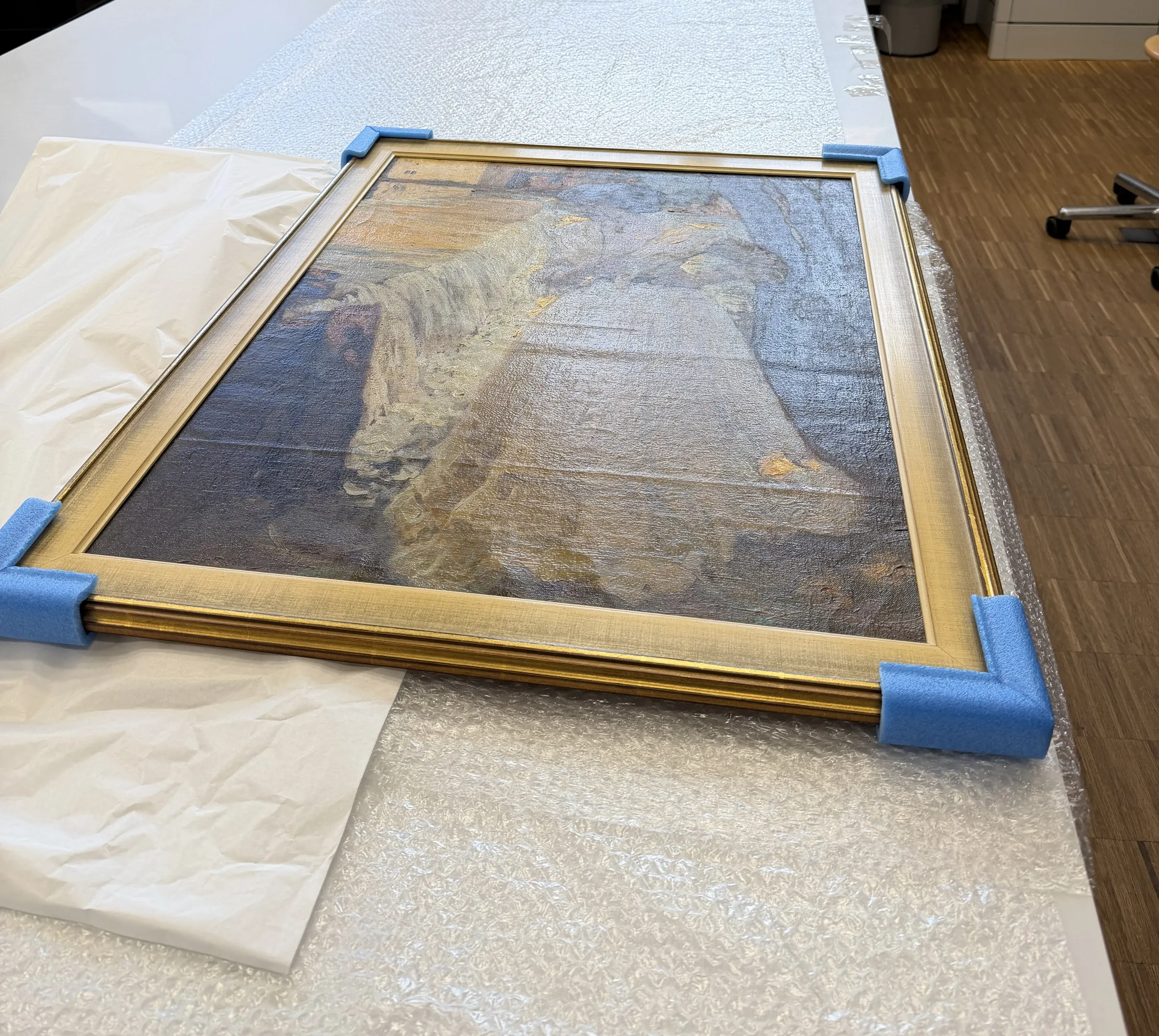
At the Restaurierungszentrum Düsseldorf, 2026: on the copy-stand wall and on the work table. Public domain. Photos: private
More than a hundred years after Barcelona, Am Wehr has an audience again. This time it is not on view in Munich, Venice or Barcelona, but here.
Sources
- Die Kunst für Alle, vol. 18 (1902/03), p. 219 (Frankfurter Kunstverein); vol. 19 (1903/04), p. 487 (reproduction of Am Wehr)
- Allgemeine Zeitung, Munich, 1 June 1904 (opening of the Deutscher Künstlerbund)
- Heidelberger Zeitung, 29 June 1904 (Künstlerbund exhibition) and 2 July 1904 (Heidelberg Kunstverein)
- Offizieller Katalog der X. Ausstellung der Münchener Secession: Der Deutsche Künstlerbund, Munich 1904, p. 29, no. 124, with plate
- VI. Esposizione Internazionale d’Arte della Città di Venezia 1905. Catalogo illustrato, p. 69, no. 30 “Sull’argine”, with plate
- Arthur Sinclair Covey: The Venice Exhibition, in: The International Studio 26 (1905), p. 222
- V Exposición Internacional de Bellas Artes é Industrias Artísticas, Barcelona 1907. Catálogo ilustrado, p. 181, Sala XXVIII, no. 31 “Sobre el Wehr”
- Münchner Neueste Nachrichten, 14 December 1913 (acquisition of the drawing “Wehr”) and 12 February 1921 (estate exhibition)
- Restaurierungszentrum der Landeshauptstadt Düsseldorf, condition report “Am Wehr”, 2026