A hero without a fig leaf
On the poster a naked hero wrestles with a bull: Theseus slaying the Minotaur. Beside him stands Pallas Athena, goddess of wisdom and protector of the arts, holding a spear and a shield on which a fierce Gorgon’s head sticks out its tongue. Below lies a wide stretch of empty space, and then, in narrow, idiosyncratic letters, the word “Secession”. Gustav Klimt designed the poster in 1898 for the first exhibition of a new artists’ association in Vienna. The censors objected to Theseus’s nudity, and for the second printing Klimt had to place a tree trunk in front of the offending spot.
The picture says what it was all about: the young, protected by art, slay the monster, the ossified art of the old associations.
Walking out
In ancient Rome, secessio was the name for the plebeians’ withdrawal from the city in protest against the patricians. In nineteenth-century Germany and Austria, large artists’ cooperatives controlled the exhibition system. They organised the annual shows, elected the juries and handed out medals, and with them commissions. Anyone who painted in a new or different way struggled to get a look in, and the exhibitions were huge and bewildering.
Munich came first. On 4 April 1892, 96 artists left the Munich Artists’ Cooperative and founded the Verein bildender Künstler Münchens, known as the Munich Secession. Among them were Fritz von Uhde, Hugo von Habermann, Franz von Stuck, Lovis Corinth and, from Berlin, Max Liebermann. It was about art, but also about money: the members wanted to decide for themselves what they exhibited and sold, and how.
Munich: a stage for Europe
Its very first exhibition, in July 1893 in its own building on Prinzregentenstraße, was international, with almost 300 artists and well over 800 works. The Secession hung pictures less densely, in calm rooms, and showed painters from France, Scandinavia and Britain alongside the Munich artists. With pictures such as Die Sünde (Sin) of 1893, a naked woman in the dark entwined by a huge serpent, Franz von Stuck gave the new movement its face.
One of the many painters who found a stage here was Carl Piepho. He joined the Secession in 1902, sat on its committee from 1904 to 1908, and with it his pictures travelled to Venice, London and Barcelona, among them Am Wehr (At the Weir). At the end of 1903 the Secessions met in Weimar and founded the Deutscher Künstlerbund as a joint umbrella organisation; its first exhibition was held in Munich in 1904.
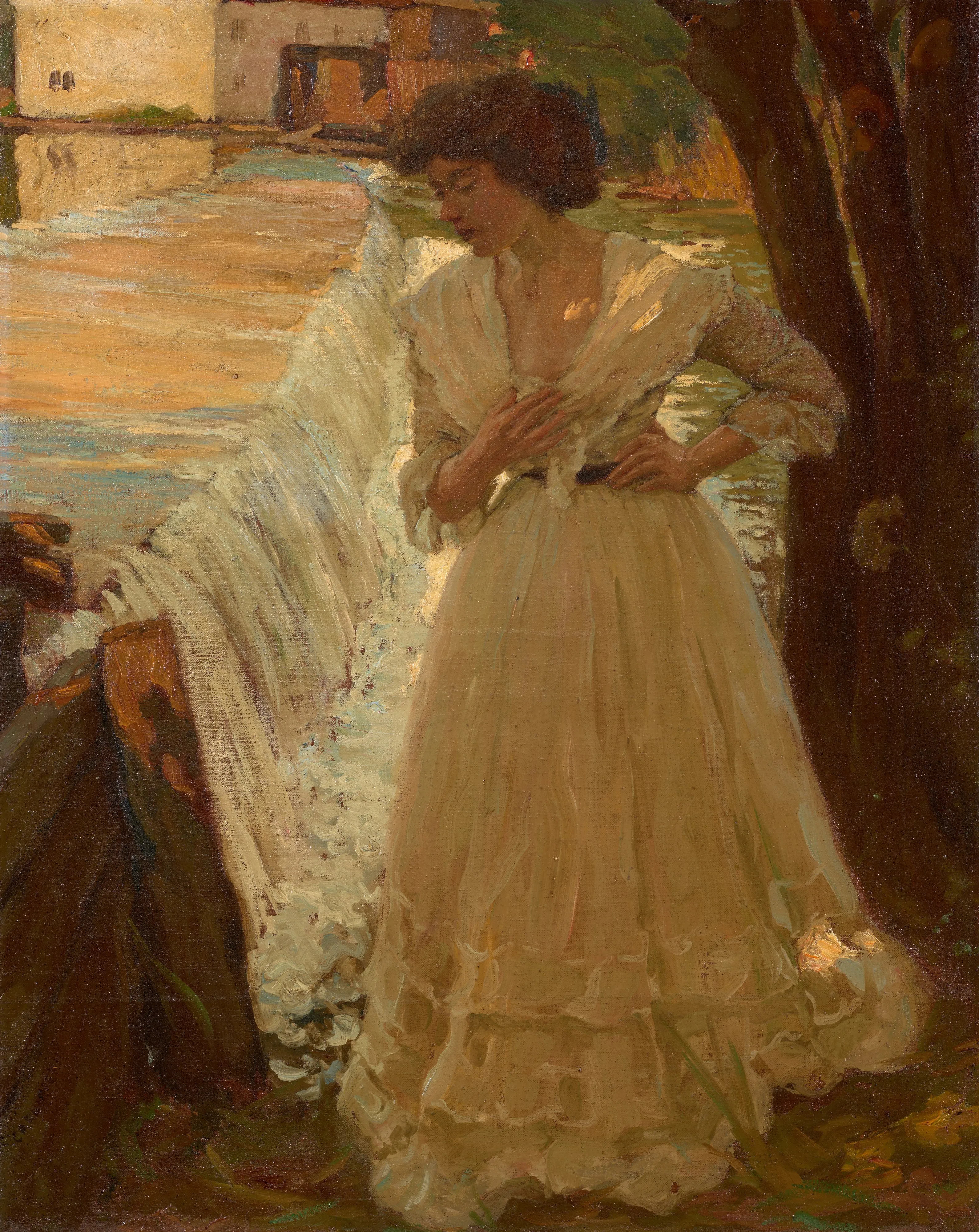
Carl Piepho, Am Wehr (At the Weir), c. 1903/04, oil on canvas, 78 × 62.5 cm, private collection. Shown in 1904 at the first exhibition of the Deutscher Künstlerbund at the Munich Secession. Public domain. Photo Restaurierungszentrum Düsseldorf
Vienna: the total work of art
Vienna followed in 1897. A group around Gustav Klimt, the painter Carl Moll and the architect Joseph Maria Olbrich left the Künstlerhaus and founded the Association of Austrian Artists – Secession, with Klimt as its first president. In the autumn of 1898 it opened its own house, designed by Olbrich: a white cube crowned by a dome of gilded laurel leaves, which the Viennese soon nicknamed the “cabbage head”. Above the entrance, to this day, are the words: “Der Zeit ihre Kunst. Der Kunst ihre Freiheit.” To every age its art, to art its freedom.
The Vienna Secession wanted to dissolve the boundaries between painting, architecture and the applied arts. Every exhibition was designed as a whole, with its own furniture, wall paintings and catalogues, and the association published its own magazine, Ver Sacrum. In 1902 it devoted an entire exhibition to Ludwig van Beethoven, built around a sculpture by Max Klinger. For it Klimt painted the Beethovenfries (Beethoven Frieze), which can again be seen in the building’s basement today. In 1905 the group split: Klimt, Moser and Hoffmann left, and the Secession concentrated more on painting.
Berlin: quarrelling with the Kaiser
In Berlin a scandal is seen as the prelude. In 1892 the Association of Berlin Artists invited the Norwegian Edvard Munch to exhibit, then closed the show after a few days amid protests from its members. In 1898 Walter Leistikow, Max Liebermann and others founded the Berlin Secession, with Liebermann as president. It showed the French Impressionists, Munch and later van Gogh, and championed painters such as Lovis Corinth and Max Slevogt.
That set it against Kaiser Wilhelm II, who wanted an uplifting, historical art and in 1901 mocked modern painting, which in his view showed only misery, as “gutter art”. Yet the Secession soon became an establishment itself. In 1910 its jury rejected pictures by the young Expressionists, including works by Max Pechstein. The rejected artists founded the Neue Secession, and in 1914 the old Berlin Secession split as well.
Why it still matters
The Secessions changed how art is shown: in calm rooms, with few works, with posters, catalogues and a consistent visual identity. Many museums still hang their collections this way. And they set a pattern that repeated itself again and again in the twentieth century: young artists found their own group because the existing institutions shut them out. Die Brücke, Der Blaue Reiter and many later groups followed their example.
Further reading
- Maria Makela: The Munich Secession. Art and Artists in Turn-of-the-Century Munich (1990).
- Peter Paret: The Berlin Secession. Modernism and Its Enemies in Imperial Germany (1980).
- Carl E. Schorske: Fin-de-Siècle Vienna. Politics and Culture (1980).